kind: proverb
Dutch: men moet zich krommen wil men door de wereld komen :audio{src="c6e945df-e3af-434d-9ee7-f81a02bd32bc/031412fe-f1b8-4cc3-9216-3bc32b57e4f2_nl_petra.mp3" lang="nl"}[1]
Word for word: one must oneself bend, will one through the world come.
What you see
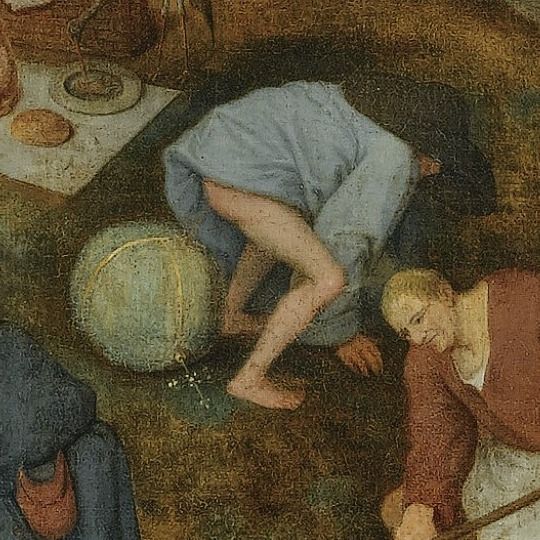
A poorly dressed man crawls on hands and knees into a large dark globe with a cross; his legs stick out behind, one foot bare.[2] Next to him, a richly dressed young man :fragment[spins the world on his thumb]{id="2c71db2a-39e1-4059-b475-2b78a84000cb"}.[2]
Meaning
To get on in the world, one has to bend: to give up one’s principles and use tricks.[3][4]
Disputed
Not every reading is so cynical. One scholar sets the crawling man against the young man with the globe on his thumb, one showing humility, the other self-confidence.[5]
Did you know?
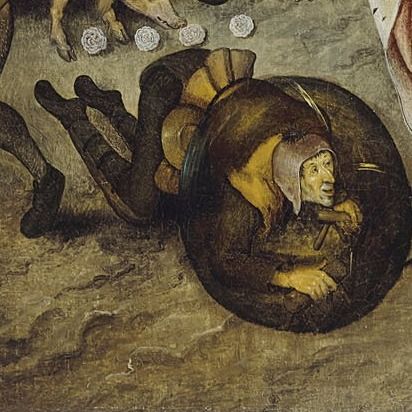
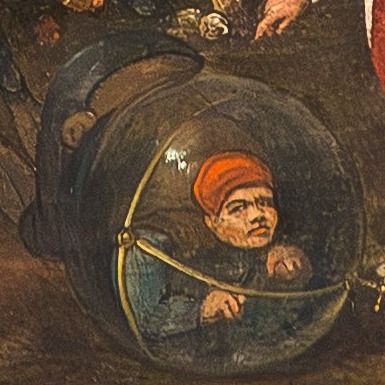
The crawling man is older than Bruegel. He appears in the border of a prayer book probably made in Ghent in the 1470s,[6] and on a panel of about 1515–20 whose verse reads met recht sovdic gerne doer de werelt commen ic bender doer mae ic moet crommen :audio{src="c6e945df-e3af-434d-9ee7-f81a02bd32bc/031412fe-f1b8-4cc3-9216-3bc32b57e4f2_nl_panel_petra.mp3" lang="nl"}: I would gladly go through the world upright, but to get through it, I must go crookedly.[3]
In other pictures
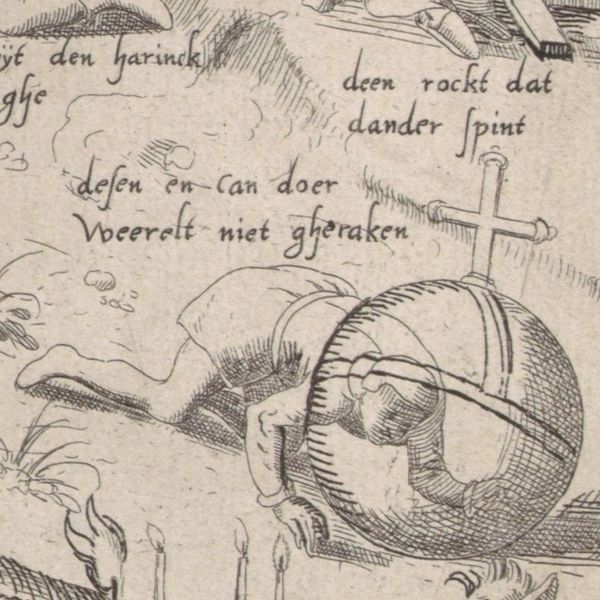
In Frans Hogenberg’s proverb print, which Bruegel most likely worked from, a man crawls into a globe topped with a cross. The caption reads desen en can doer weerelt niet gheraken :audio{src="c6e945df-e3af-434d-9ee7-f81a02bd32bc/031412fe-f1b8-4cc3-9216-3bc32b57e4f2_nl_hogenberg_petra.mp3" lang="nl"}, this one cannot get through the world.[7][8]
::other-pictures
 ::
The painting
::painting-intro ::
::sources
Roger H. Marijnissen, in Seidel and Marijnissen, Bruegel (New York, 1971), 40, no. 23.
Visible in the painting.
Walter S. Gibson, Figures of Speech (Berkeley, 2010), 27–28, 170 n. 46.
David Kunzle, “Bruegel’s Proverb Painting and the World Upside Down,” The Art Bulletin 59 (1977), 202.
Mark A. Meadow, Pieter Bruegel the Elder’s Netherlandish Proverbs and the Practice of Rhetoric (Zwolle, 2002), 41.
Walter S. Gibson, Figures of Speech (Berkeley, 2010), 21.
Walter S. Gibson, Figures of Speech (Berkeley, 2010), 35.
Visible in the print: Frans Hogenberg, Die Blau Huicke, published by 1558; Rijksmuseum, Amsterdam. ::