kind: noun, a mocking nickname[1]
Dutch: een pilaarbijter :audio{src="c6e945df-e3af-434d-9ee7-f81a02bd32bc/0b64b799-0e3b-4326-a315-6fe73ae6e52e_nl_petra.mp3" lang="nl"}
What you see
A man wraps both arms around a column, his mouth pressed to the stone. His eyes are wide open and turned away from it. The column is broken off at the top, and a hat lies on the stump.[2]
Meaning
A hypocrite in a holy place:[3] someone who goes to church to be seen there,[4] superstitious and idle, sitting about “as though gnawing the columns.”[3]
Elsewhere
French has the same joke: un mangeur de crucifix :audio{src="c6e945df-e3af-434d-9ee7-f81a02bd32bc/0b64b799-0e3b-4326-a315-6fe73ae6e52e_fr_mangeur_de_crucifix.mp3" lang="fr"}, a crucifix-eater.[1]
Did you know?
Pictures of saints used to hang on church columns, so the devout prayed with their faces close to the stone. Nobody can see into a man’s prayer, but everyone can see how close he stands, and the nickname mocks exactly that: press close enough and you are no longer praying at the column, you are eating it.[1] Bruegel’s column is broken and holds no picture. The devotion has lost its object and kept its audience.
In other pictures
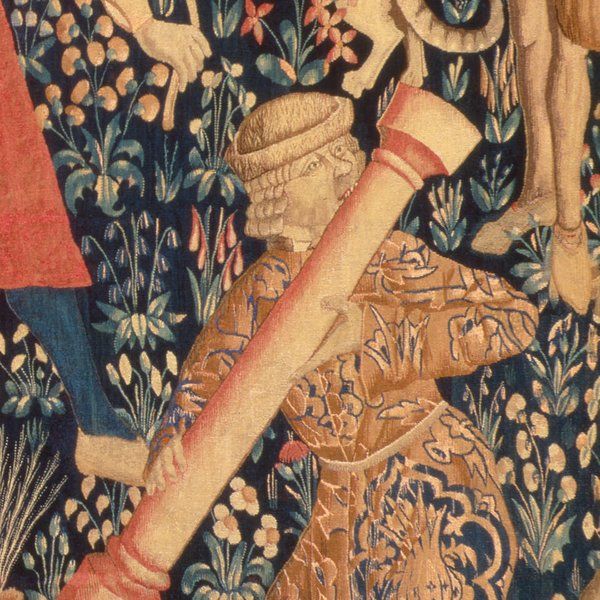
Bruegel did not invent him. A pillar-biter already appears in a Flemish proverb tapestry from about 1500, now in Boston, which also has :fragment[someone carrying fire in one hand and water in the other]{id="5db50bca-5ac9-4b09-9ecc-c965afae4a90"} and :fragment[a wife hanging a blue cloak on her husband]{id="150c5cd9-1328-43e7-89d3-5ab7f56dc711"}.[5]
::other-pictures
 ::
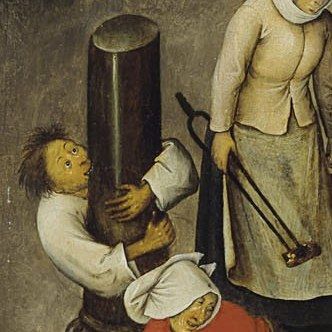
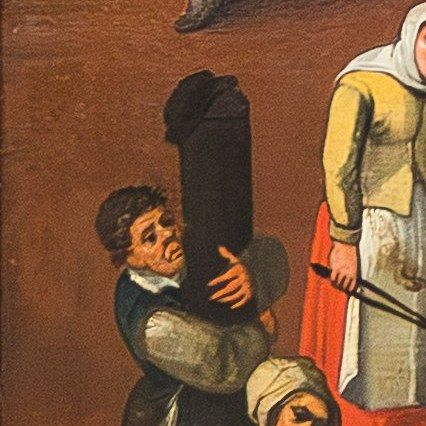
In the copy by Bruegel’s son, the column is whole, with no hat on top.[6]
::other-pictures
 ::
The painting
::painting-intro ::
::sources
F. A. Stoett, Nederlandsche spreekwoorden, 4th ed. (Zutphen, 1923–25), no. 1829.
Visible in the painting.
Cornelis Kiliaan, Etymologicum teutonicae linguae (Antwerp, 1599), 402.
François Halma, quoted in Stoett, no. 1829.
Walter S. Gibson, Figures of Speech (Berkeley, 2010), 27–28 and 170 n. 41. Date and image of the tapestry: Isabella Stewart Gardner Museum, Boston, Proverbs, about 1500.
Visible in the copies: Pieter Brueghel the Younger, sold at Christie’s, 2018; Suermondt-Ludwig-Museum, Aachen (Wikimedia Commons). ::