kind: proverb
Dutch: als het kalf verdronken is, dempt men de put :audio{src="c6e945df-e3af-434d-9ee7-f81a02bd32bc/0d06676a-e602-4fcc-af4c-e3be8c998001_nl_petra.mp3" lang="nl"}[1]
What you see
A man in a white shirt shovels earth into a pit of water. At the bottom, the head of a drowned calf sticks out, its eye open.[2]
Meaning
To do something in vain and too late, when it can no longer help, “like preparing medicine after the sick man has died.”[1]
Elsewhere
English locks the stable door when the horse is stolen.[1] Dutch had that version too: in 1568, ’t is te late den stal sluyten, als het peerdt verloren is :audio{src="c6e945df-e3af-434d-9ee7-f81a02bd32bc/0d06676a-e602-4fcc-af4c-e3be8c998001_nl_stal_petra.mp3" lang="nl"}, it is too late to shut the stable when the horse is lost.[3]
Did you know?
In the oldest Dutch proverb collections, it is not a calf that drowns but a child: als ’t kint verdroncken is, so stopt men den put :audio{src="c6e945df-e3af-434d-9ee7-f81a02bd32bc/0d06676a-e602-4fcc-af4c-e3be8c998001_nl_kint_petra.mp3" lang="nl"}, when the child has drowned, they stop up the well.[1]
In other pictures
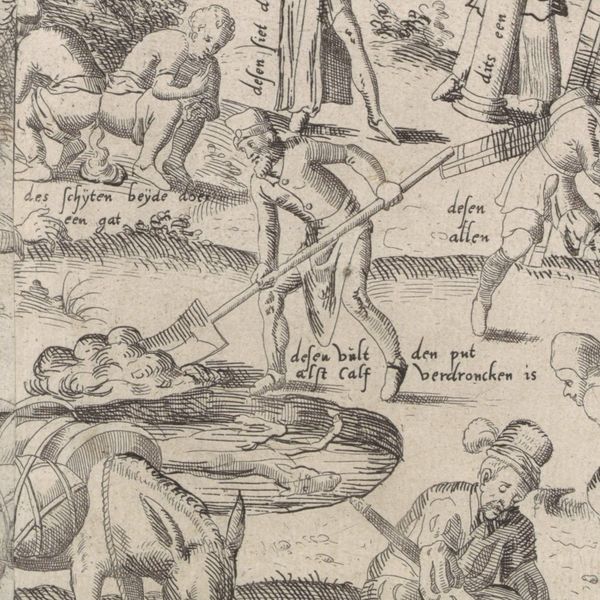
By Bruegel’s time the calf was there: Frans Hogenberg’s proverb print, which Bruegel most likely worked from, has the man with the shovel and a caption that names the calf.[4][5]
::other-pictures
 ::
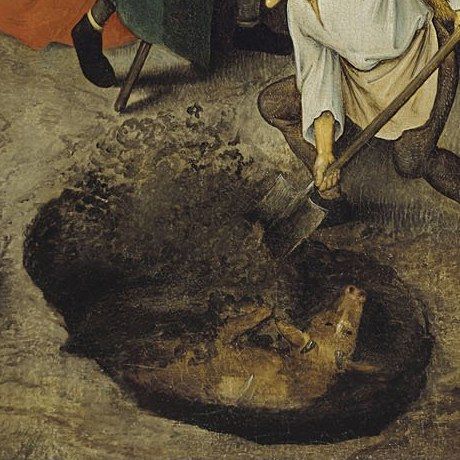
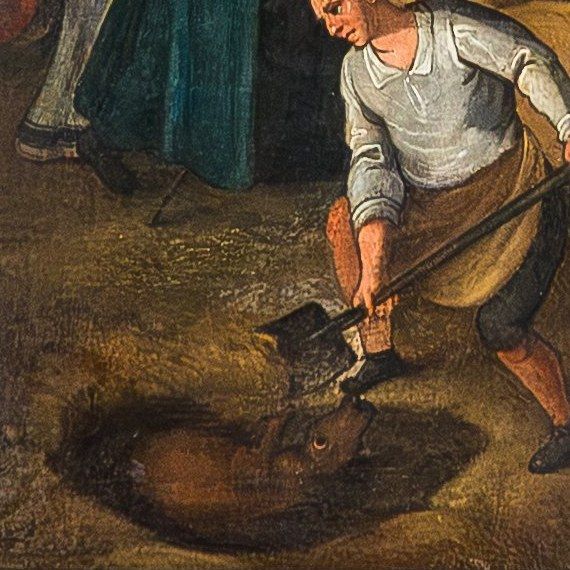
In two later copies, the whole calf lies at the bottom of the pit.[6]
::other-pictures
 ::
The painting
::painting-intro ::
::sources
F. A. Stoett, Nederlandsche spreekwoorden, 4th ed. (Zutphen, 1923–25), no. 1058, quoting Tuinman for the meaning and the Proverbia communia for the child.
Visible in the painting.
François Goedthals, Les proverbes anciens flamengs et françois (Antwerp, 1568), 18.
Walter S. Gibson, Figures of Speech (Berkeley, 2010), 35.
Visible in the print: Frans Hogenberg, Die Blau Huicke, published by 1558; Rijksmuseum, Amsterdam.
Visible in the copies: Pieter Brueghel the Younger, sold at Christie’s, 2018; Suermondt-Ludwig-Museum, Aachen (Wikimedia Commons). ::