kind: phrase
Dutch: twee honden aan één been :audio{src="c6e945df-e3af-434d-9ee7-f81a02bd32bc/0d10f45d-fbaa-4af2-a47e-cc4da69dacba_nl_petra.mp3" lang="nl"}[1]
What you see
A shaggy black dog and a lean white dog have their mouths at the two ends of one bone.[2]
Meaning
Two people lay claim to the same thing, and fight over it, or soon will.[1]
Elsewhere
In 1568 French had it in the same words, deux chiens à un os :audio{src="c6e945df-e3af-434d-9ee7-f81a02bd32bc/0d10f45d-fbaa-4af2-a47e-cc4da69dacba_fr_deux_chiens.mp3" lang="fr"}.[3]
Did you know?
Late medieval Dutch made a rhyme of it: daer twee honden knaegen an een been, die draegen sich selden overeen :audio{src="c6e945df-e3af-434d-9ee7-f81a02bd32bc/0d10f45d-fbaa-4af2-a47e-cc4da69dacba_nl_rijm_petra.mp3" lang="nl"}, where two dogs gnaw at one bone, they seldom get along. In the 1600s a third dog joined in: when two dogs fight over a bone, the third runs off with it.[4]
In other pictures
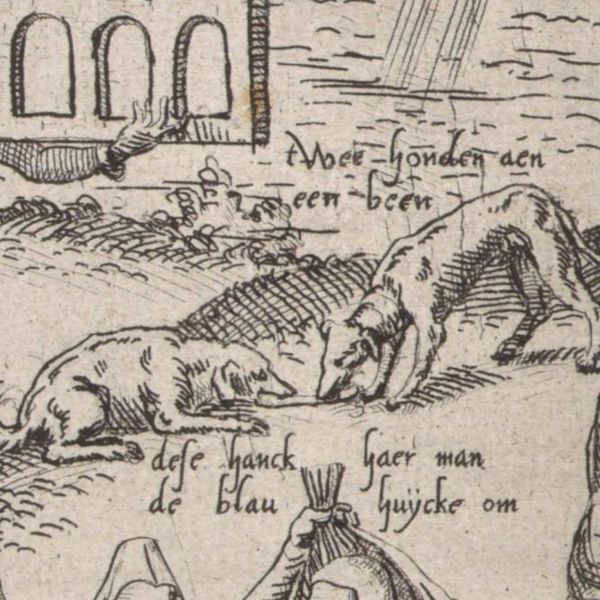
Frans Hogenberg’s proverb print, which Bruegel most likely worked from, has the two dogs with these very words as their caption.[5][6]
::other-pictures
 ::
The painting
::painting-intro ::
::sources
Roger H. Marijnissen, in Seidel and Marijnissen, Bruegel (New York, 1971), 40, no. 26.
Visible in the painting.
François Goedthals, Les proverbes anciens flamengs et françois (Antwerp, 1568), 22.
F. A. Stoett, Nederlandsche spreekwoorden, 4th ed. (Zutphen, 1923–25), no. 919.
Walter S. Gibson, Figures of Speech (Berkeley, 2010), 35.
Visible in the print: Frans Hogenberg, Die Blau Huicke, published by 1558; Rijksmuseum, Amsterdam. ::