kind: phrase
Dutch: tot de tanden gewapend zijn :audio{src="c6e945df-e3af-434d-9ee7-f81a02bd32bc/13e5ad09-198d-45a6-b9ea-a01573130441_nl_petra.mp3" lang="nl"}[1][2]
What you see
Behind a low wall, a man in full armor and a steel hat leans over a striped cat, a knife held crosswise in his teeth; only his upper body shows. He is the man who :fragment[ties the bell on the cat]{id="22a23df6-3c91-4cd8-a3b8-730ab29b593c"}.[3]
Meaning
Fully armed; also said of other things than weapons.[1] In the seventeenth century the Dutch writer Hooft has people stuck ten tanden toe, in schulden :audio{src="c6e945df-e3af-434d-9ee7-f81a02bd32bc/13e5ad09-198d-45a6-b9ea-a01573130441_nl_hooft_petra.mp3" lang="nl"}, up to the teeth in debts.[1]
Elsewhere
French says armé jusqu’aux dents :audio{src="c6e945df-e3af-434d-9ee7-f81a02bd32bc/13e5ad09-198d-45a6-b9ea-a01573130441_fr_arme.mp3" lang="fr"} today; in the 1920s it also had savant jusqu’aux dents :audio{src="c6e945df-e3af-434d-9ee7-f81a02bd32bc/13e5ad09-198d-45a6-b9ea-a01573130441_fr_savant.mp3" lang="fr"}, learned to the teeth.[1]
Did you know?
It was unusual to give the man who bells the cat a suit of armor.[4] In the old fable the one who had to tie on the bell was a mouse. One scholar reads so much gear for so small a task as a quiet joke at the Spanish.[5] The Low Countries were then ruled by the Spanish king, Philip II, through his regent, Margaret of Parma,[6] and Spanish troops stayed on there, to the bitter complaints of the local people.[5]
In other pictures
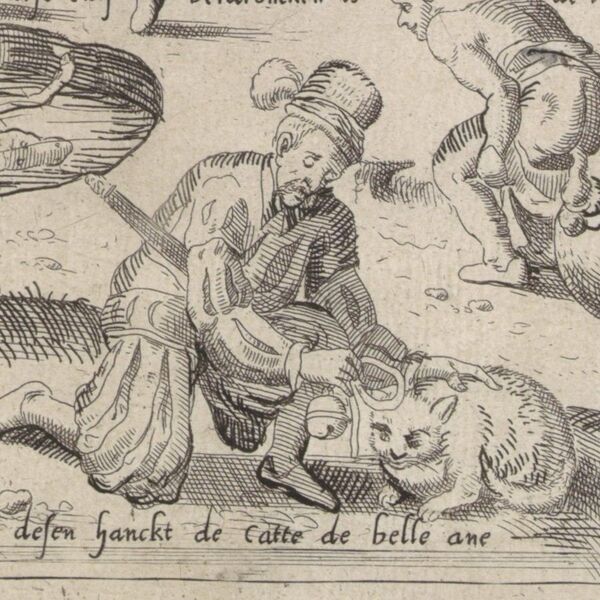
In Frans Hogenberg’s proverb print, which Bruegel most likely worked from, the man who bells the cat wears showy clothes, not armor.[7][8][5]
::other-pictures
 ::
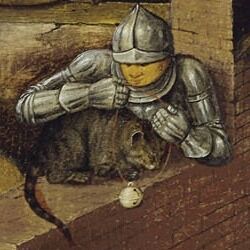
In the copies by Bruegel’s son, the knife is gone.[9][10]
::other-pictures
 ::
The painting
::painting-intro ::
::sources
F. A. Stoett, Nederlandsche spreekwoorden, 4th ed. (Zutphen, 1923–25), no. 2233.
Roger H. Marijnissen, in Seidel and Marijnissen, Bruegel (New York, 1971), 40, no. 11.
Visible in the painting.
Margaret A. Sullivan, Bruegel and the Creative Process, 1559–1563 (Farnham, 2010), 41, citing David Kunzle, “Belling the Cat—Butting the Wall: Military Elements in Bruegel’s Netherlandish Proverbs,” in The Netherlandish Proverbs: An International Symposium, ed. Wolfgang Mieder (2004), 144–45.
Margaret A. Sullivan, Bruegel and the Creative Process, 1559–1563 (Farnham, 2010), 41.
Margaret A. Sullivan, Bruegel and the Creative Process, 1559–1563 (Farnham, 2010), 127.
Walter S. Gibson, Figures of Speech (Berkeley, 2010), 35.
Visible in the print: Frans Hogenberg, Die Blau Huicke, published by 1558; Rijksmuseum, Amsterdam.
Margaret A. Sullivan, Bruegel and the Creative Process, 1559–1563 (Farnham, 2010), 34.
Visible in the copy. ::