kind: saying
Dutch: zij hangt haar man de blauwe huik om :audio{src="c6e945df-e3af-434d-9ee7-f81a02bd32bc/150c5cd9-1328-43e7-89d3-5ab7f56dc711_nl_petra.mp3" lang="nl"}[1]
What you see
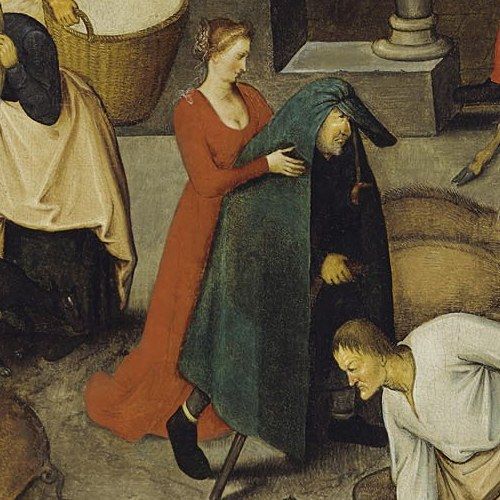
A young woman in a red dress lays a blue cloak over an old man with both hands. It covers him from head to foot and rises above his head in a pointed hood. He walks bent over, leaning on a stick.[2]
Meaning
She deceives her husband: she is unfaithful to him.[1] The blue cloak could also stand for deceit in general, much like “to hoodwink.”[3]
Did you know?
A huik :audio{src="c6e945df-e3af-434d-9ee7-f81a02bd32bc/150c5cd9-1328-43e7-89d3-5ab7f56dc711_nl_huik_petra.mp3" lang="nl"} was a long sleeveless cloak worn by men and women alike, reaching to the feet, its front drawn up over the head into a long horn.[4]
In other pictures
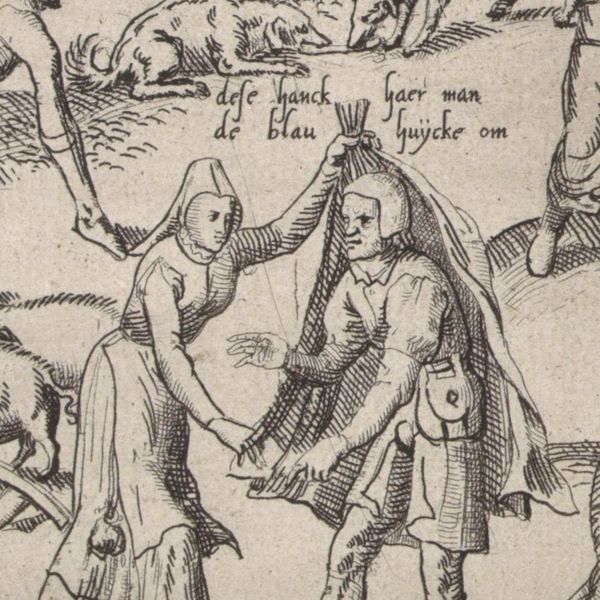
The scene gave its name to Frans Hogenberg’s proverb print, which Bruegel most likely worked from: Die Blau Huicke, the blue cloak.[3] There the wife holds the cloak up by its tip as she lowers it over her husband.[5]
::other-pictures
 ::
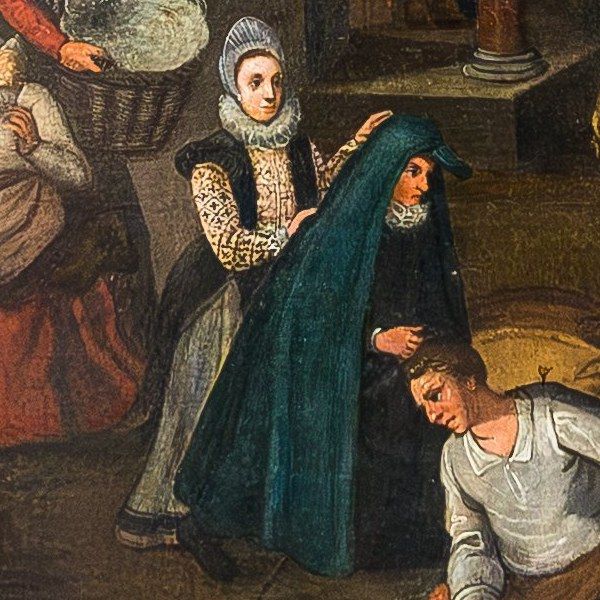
Later copies change small things: in the one in Aachen, the wife wears a white ruff, a pleated collar.[6]
::other-pictures
 ::
The painting
::painting-intro ::
::sources
Roger H. Marijnissen, in Seidel and Marijnissen, Bruegel (New York, 1971), 40, no. 21.
Visible in the painting.
Walter S. Gibson, Figures of Speech (Berkeley, 2010), 35–37.
F. A. Stoett, Nederlandsche spreekwoorden, 4th ed. (Zutphen, 1923–25), no. 981.
Visible in the print: Frans Hogenberg, Die Blau Huicke, published by 1558; Rijksmuseum, Amsterdam.
Visible in the copies: Pieter Brueghel the Younger, sold at Christie’s, 2018; Suermondt-Ludwig-Museum, Aachen (Wikimedia Commons). ::