kind: phrase
Dutch: de haring braden om de kuit :audio{src="c6e945df-e3af-434d-9ee7-f81a02bd32bc/182d0864-5fb2-4fb0-b5da-e61ba81ac9cf_nl_petra.mp3" lang="nl"}[1]
What you see
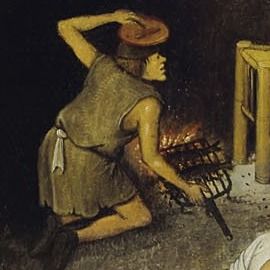
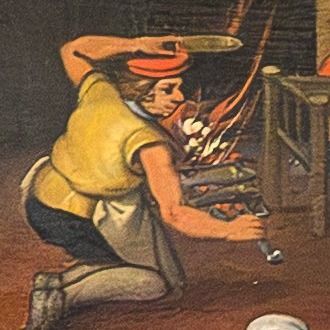
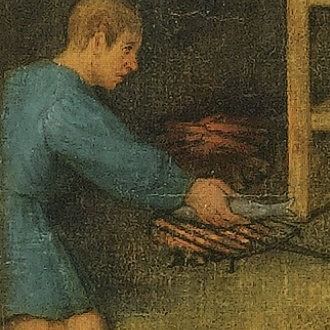
Herrings lie on an iron grill over glowing coals; a bare-legged man crouches beside it and reaches for one.[2]
Meaning
To throw one’s money away.[1][3] It was said of wasteful gourmands.[4]
Elsewhere
A Dutch dictionary of 1573, with French and Latin, gives it in French: rostir le hareng pour avoir l’oeuf :audio{src="c6e945df-e3af-434d-9ee7-f81a02bd32bc/182d0864-5fb2-4fb0-b5da-e61ba81ac9cf_fr_rostir.mp3" lang="fr"}, to roast the herring to get the egg.[5]
Disputed
The 1573 dictionary also glosses it with a Latin saying, to lose oil and labor, which would make it working in vain.[6] A later dictionary replies that money, not labor, is meant.[3] A collection of 1606 uses it the other way: to do someone a service in the hope of a reward.[7]
Did you know?
An older form of the saying appears in a Middle Dutch poem about the things people delight in, in a manuscript of about 1400–1420: selc die gans coert om die craghe, selc coert den herinc om den roghe :audio{src="c6e945df-e3af-434d-9ee7-f81a02bd32bc/182d0864-5fb2-4fb0-b5da-e61ba81ac9cf_nl_poem_petra.mp3" lang="nl"}, one chooses the goose for its neck, another the herring for its roe, for the pleasures of the palate.[3][8] A play of the early seventeenth century still has: Gy dunckt my een trawantgen die om de kuijte den haring braet :audio{src="c6e945df-e3af-434d-9ee7-f81a02bd32bc/182d0864-5fb2-4fb0-b5da-e61ba81ac9cf_nl_play_petra.mp3" lang="nl"}, you look to me like a vassal who would fry the herring for the roe.[1]
In other pictures
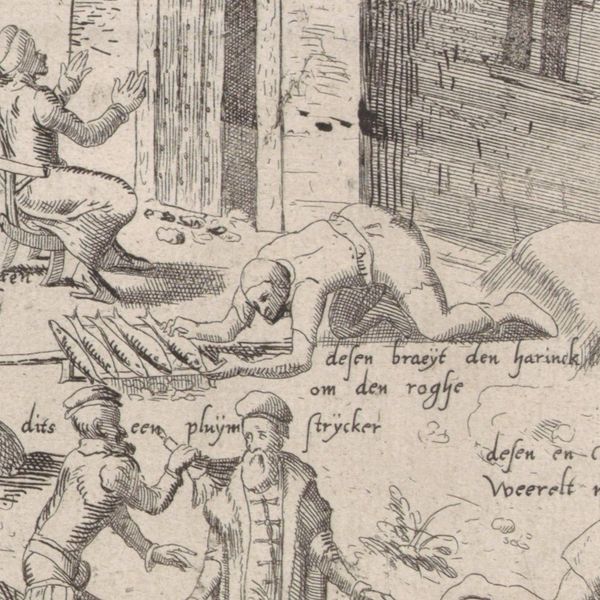
In Frans Hogenberg’s proverb print, which Bruegel most likely worked from, a man stretches out on the ground by a grill of herrings. The caption reads desen braeyt den harinck om den roghe :audio{src="c6e945df-e3af-434d-9ee7-f81a02bd32bc/182d0864-5fb2-4fb0-b5da-e61ba81ac9cf_nl_hogenberg_petra.mp3" lang="nl"}, this one fries the herring for the roe. Roghe :audio{src="c6e945df-e3af-434d-9ee7-f81a02bd32bc/182d0864-5fb2-4fb0-b5da-e61ba81ac9cf_nl_roghe_petra.mp3" lang="nl"} and kuit :audio{src="c6e945df-e3af-434d-9ee7-f81a02bd32bc/182d0864-5fb2-4fb0-b5da-e61ba81ac9cf_nl_kuit_petra.mp3" lang="nl"} meant the same thing: fish eggs.[9][10][11]
::other-pictures
 ::
The painting
::painting-intro ::
::sources
Roger H. Marijnissen, in Seidel and Marijnissen, Bruegel (New York, 1971), 39, no. 4.
Visible in the painting.
J. Verdam, Middelnederlandsch woordenboek, vol. 6, col. 1562, s.v. “Roge (I).”
Woordenboek der Nederlandsche Taal, vol. 3, col. 983, s.v. “Braden.”
Christophe Plantin, Thesaurus theutonicae linguae (Antwerp, 1573), quoted in J. Verdam, Middelnederlandsch woordenboek, vol. 6, col. 1562, s.v. “Roge (I).”
Christophe Plantin, Thesaurus theutonicae linguae (Antwerp, 1573), quoted in Woordenboek der Nederlandsche Taal, vol. 5, col. 2213, s.v. “Haring.”
Donaes Idinau, Lot van wijsheyd ende goed geluck (Antwerp, 1606), 123, as summarized in Woordenboek der Nederlandsche Taal, vol. 3, col. 983, s.v. “Braden.”
Een beghinsel van allen spelen, lines 20–21, in A. H. Hoffmann von Fallersleben, Horae Belgicae, vol. 6 (Breslau, 1838), 1.
Cornelis Kiliaan, Etymologicum teutonicae linguae (Antwerp, 1599), 267, 441.
Walter S. Gibson, Figures of Speech (Berkeley, 2010), 35.
Visible in the print: Frans Hogenberg, Die Blau Huicke, published by 1558; Rijksmuseum, Amsterdam. ::