kind: phrase
Dutch: een aal (of een paling) bij den staart hebben :audio{src="c6e945df-e3af-434d-9ee7-f81a02bd32bc/1dfde89c-bf84-4330-ac80-dcc9372f9877_nl_petra.mp3" lang="nl"}[1]
What you see
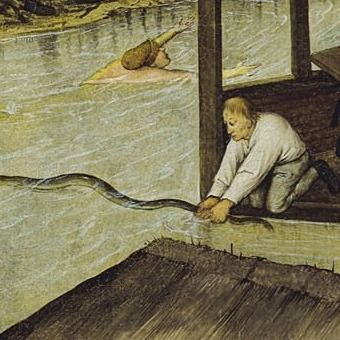
At the water’s edge, a man leans out of a doorway and grips a long eel by the tail.[2] Above him, a man :fragment[swims against the stream]{id="cda7091f-ac85-43b8-927a-e1e0d6c5b744"}.[2]
Meaning
To take on something that will probably slip out of one’s hands or fail; a risky undertaking.[1][3] It was also said of dealings with people who cannot be trusted.[1]
Elsewhere
A Flemish–French book of 1568 pairs it with a grand pêcheur eschappe anguille :audio{src="c6e945df-e3af-434d-9ee7-f81a02bd32bc/1dfde89c-bf84-4330-ac80-dcc9372f9877_fr_pecheur.mp3" lang="fr"}, the eel escapes even a great fisherman.[4] English had “there’s as much hold of his word as there is of a wet eel by the tail.”[3]
Did you know?
A Middle Dutch poem says that a woman whose will is not done is as hard to hold as a living eel by its tail in the stream: alse es te houdene in die vloet een levende ael met sinen steerte :audio{src="c6e945df-e3af-434d-9ee7-f81a02bd32bc/1dfde89c-bf84-4330-ac80-dcc9372f9877_nl_rose_petra.mp3" lang="nl"}.[5]
In other pictures
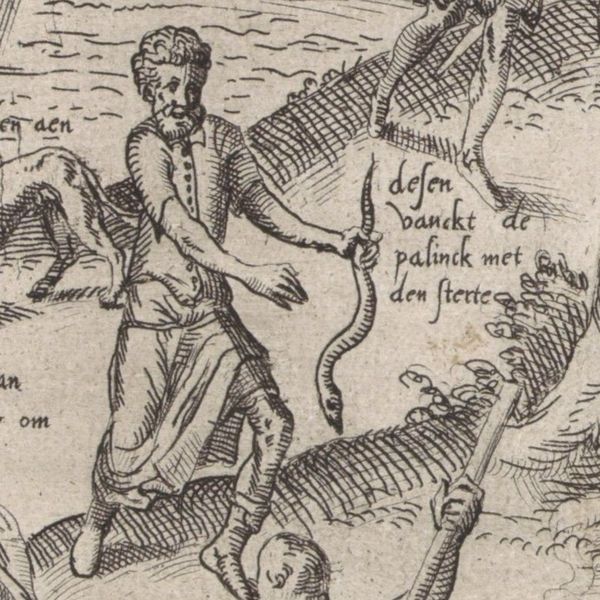
In Frans Hogenberg’s proverb print, which Bruegel most likely worked from, a man holds up an eel by its tail. The caption reads desen vanckt de palinck met den sterte :audio{src="c6e945df-e3af-434d-9ee7-f81a02bd32bc/1dfde89c-bf84-4330-ac80-dcc9372f9877_nl_hogenberg_petra.mp3" lang="nl"}, this one catches the eel by the tail.[6][7]
::other-pictures
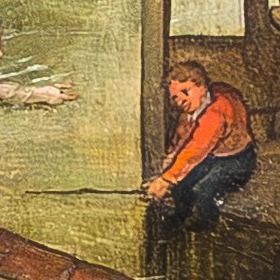 ::
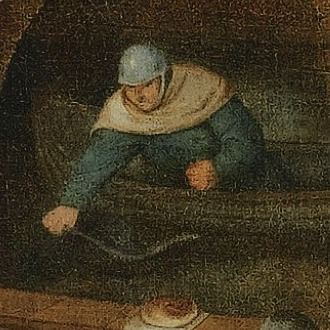
In a later copy by a follower of Bruegel, the man holds the eel from a boat.[8]
::other-pictures
 ::
The painting
::painting-intro ::
::sources
F. A. Stoett, Nederlandsche spreekwoorden, 4th ed. (Zutphen, 1923–25), no. 7.
Visible in the painting.
Roger H. Marijnissen, in Seidel and Marijnissen, Bruegel (New York, 1971), 42, no. 69.
François Goedthals, Les proverbes anciens flamengs et françois (Antwerp, 1568), 18.
F. A. Stoett, Nederlandsche spreekwoorden, 4th ed. (Zutphen, 1923–25), no. 5.
Walter S. Gibson, Figures of Speech (Berkeley, 2010), 35.
Visible in the print: Frans Hogenberg, Die Blau Huicke, published by 1558; Rijksmuseum, Amsterdam.
Visible in the copy: follower of Pieter Bruegel the Elder, sold at Sotheby’s, London, 2012, lot 7 (Wikimedia Commons). ::