kind: saying
Dutch: hij draagt de dag met manden uit :audio{src="c6e945df-e3af-434d-9ee7-f81a02bd32bc/1f14853e-42d7-4a0f-8ddf-c07b156fa40d_nl_petra.mp3" lang="nl"}[1]
What you see
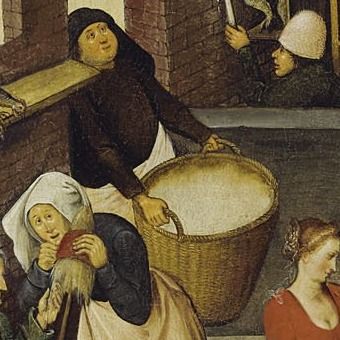
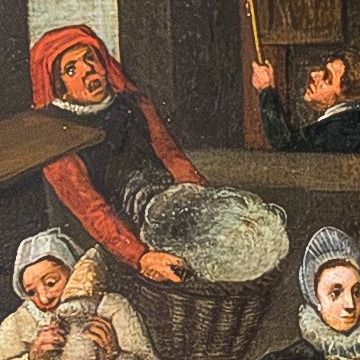
A man leans back as he carries a big basket brimming with white light out of a doorway.[2]
Meaning
To waste one’s time, to idle the hours away.[1]
Did you know?
In the Middle Ages the Dutch word dag :audio{src="c6e945df-e3af-434d-9ee7-f81a02bd32bc/1f14853e-42d7-4a0f-8ddf-c07b156fa40d_nl_dag_petra.mp3" lang="nl"}, day, also meant daylight, sunlight.[3] Bruegel’s basket and the room behind the man glow white.[2][4]
In other pictures
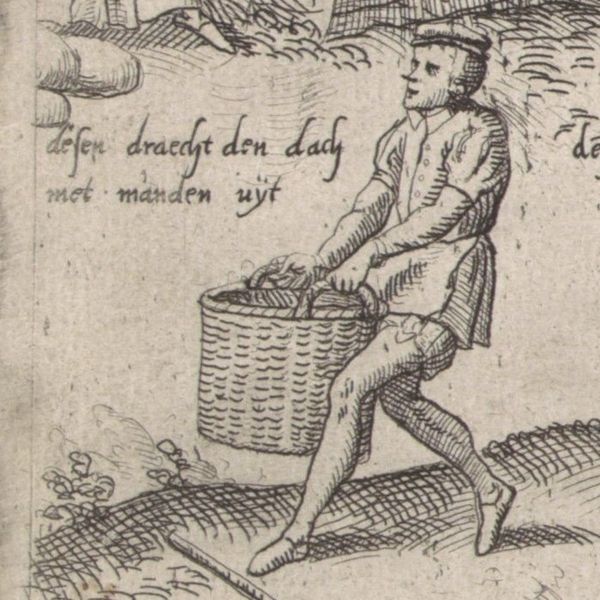
In Frans Hogenberg’s proverb print, which Bruegel most likely worked from, a man walks along with a basket. The caption reads desen draecht den dach met manden uyt :audio{src="c6e945df-e3af-434d-9ee7-f81a02bd32bc/1f14853e-42d7-4a0f-8ddf-c07b156fa40d_nl_hogenberg_petra.mp3" lang="nl"}, this one carries the day out with baskets.[5][6]
::other-pictures
 ::
The painting
::painting-intro ::
::sources
Roger H. Marijnissen, in Seidel and Marijnissen, Bruegel (New York, 1971), 40, no. 16.
Visible in the painting.
F. A. Stoett, Nederlandsche spreekwoorden, 4th ed. (Zutphen, 1923–25), no. 391.
Mark A. Meadow, Pieter Bruegel the Elder’s Netherlandish Proverbs and the Practice of Rhetoric (Zwolle, 2002), 100.
Walter S. Gibson, Figures of Speech (Berkeley, 2010), 35.
Visible in the print: Frans Hogenberg, Die Blau Huicke, published by 1558; Rijksmuseum, Amsterdam. ::