kind: saying
Dutch: de vos en de kraan hebben elkander te gast :audio{src="c6e945df-e3af-434d-9ee7-f81a02bd32bc/205171ab-1038-436d-81d8-11d99f2490d9_nl_petra.mp3" lang="nl"}[1]
What you see
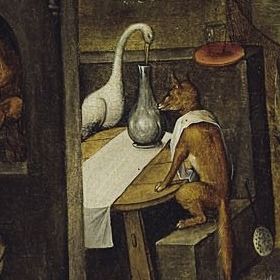
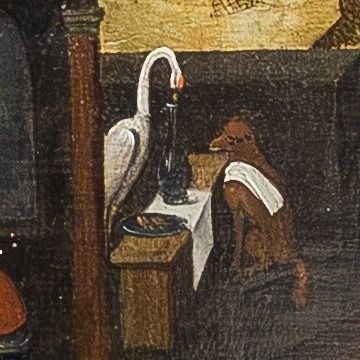
A fox with a white napkin around his neck sits on a stone block at a small round table, in front of a flat plate. Across the table, a crane dips its beak into a tall jug.[2]
Meaning
Two tricksters who have tricked each other.[1]
Did you know?
The saying comes from a fable told since Aesop. A fox invites a stork to dinner and serves thin broth on a flat plate: he laps it up in a moment, while her long beak cannot pick up a drop. She invites him back and serves the meat in a vase with a long, narrow neck: her beak slips in easily, his snout does not fit. La Fontaine ends it: Attendez-vous à la pareille :audio{src="c6e945df-e3af-434d-9ee7-f81a02bd32bc/205171ab-1038-436d-81d8-11d99f2490d9_fr_attendez_vous.mp3" lang="fr"}, expect the same in return.[3] In the Netherlands the stork became a crane: a Dutch book of 1606 calls the fable “The crane has invited the fox.”[4] Bruegel sets both dinners on one table, the plate and the jug together.[2]
In other pictures
::other-pictures
 ::
The painting
::painting-intro ::
::sources
Roger H. Marijnissen, in Seidel and Marijnissen, Bruegel (New York, 1971), 40, no. 27.
Visible in the painting.
Jean de La Fontaine, Fables (Paris, 1668), book 1, fable 18, “Le Renard et la Cigogne.”
Walter S. Gibson, Figures of Speech (Berkeley, 2010), 159 n. 23. ::