kind: phrase
Dutch: de kat de bel aanbinden :audio{src="c6e945df-e3af-434d-9ee7-f81a02bd32bc/22a23df6-3c91-4cd8-a3b8-730ab29b593c_nl_petra.mp3" lang="nl"}[1]
What you see
A man in full armor, a steel hat on his head and a knife crosswise in his teeth, ties a cord around the neck of a tabby cat crouching on a low brick wall. The bell hangs from the cord over the edge of the wall.[2]
Meaning
To take the first step in a dangerous undertaking;[1] to attempt a difficult task.[3]
Elsewhere
English has the same picture, to bell the cat, written down as early as 1362; French says attacher le grelot :audio{src="c6e945df-e3af-434d-9ee7-f81a02bd32bc/22a23df6-3c91-4cd8-a3b8-730ab29b593c_fr_attacher_le_grelot.mp3" lang="fr"}, to tie on the bell.[1]
Did you know?
The phrase comes from a fable. The mice agreed to hang a bell on the cat so they would hear it coming, but when it came to doing it, none of them dared.[1] Some Arabic manuscripts of Kalila and Dimna, a book of animal fables that goes back to the Indian Panchatantra, tell it as a council of state. A king of the rats asks his three ministers how to free the rats from their fear of cats. The lowest of them advises tying a bell to every cat’s neck, and the next asks who would tie it on.[4]
A century after Bruegel, La Fontaine retold the fable in French verse. A cat named Rodilardus has killed so many rats that the rest hold a council, and their dean proposes the bell. Everyone agrees. Then comes the catch: La difficulté fut d’attacher le grelot :audio{src="c6e945df-e3af-434d-9ee7-f81a02bd32bc/22a23df6-3c91-4cd8-a3b8-730ab29b593c_fr_la_difficulte.mp3" lang="fr"}, the hard part was tying on the bell. No rat would do it.[5][3]
In other pictures
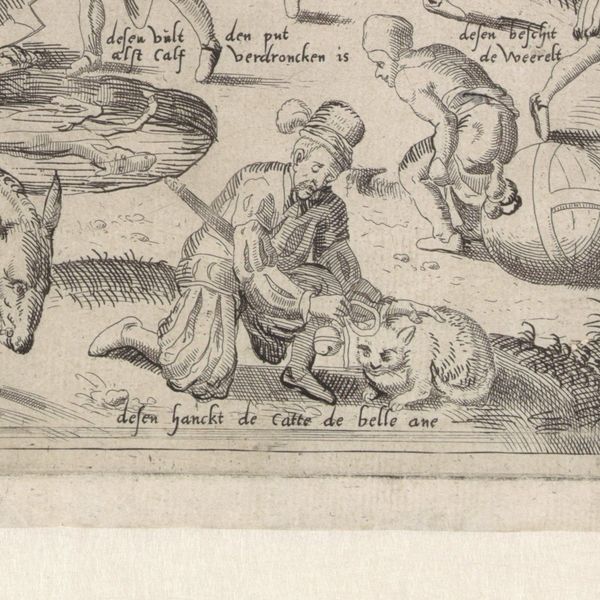
Frans Hogenberg’s proverb print, which Bruegel most likely worked from,[6] has the scene too, with the saying as its caption. His man kneels in ordinary clothes, without armor.[7]
::other-pictures
 ::
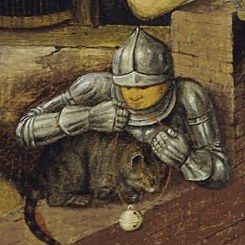
In the copy by Bruegel’s son, no knife can be seen in his teeth.[8]
::other-pictures
 ::
The painting
::painting-intro ::
::sources
F. A. Stoett, Nederlandsche spreekwoorden, 4th ed. (Zutphen, 1923–25), no. 1094.
Visible in the painting.
Roger H. Marijnissen, in Seidel and Marijnissen, Bruegel (New York, 1971), 40, no. 10.
Antoine Isaac Silvestre de Sacy, Calila et Dimna, ou Fables de Bidpai, en arabe (Paris, 1816), introduction, 33–34 and 61–63. On the book’s descent from the Panchatantra: Theodor Benfey, Pantschatantra, vol. 1 (Leipzig, 1859).
Jean de La Fontaine, Fables (Paris, 1668), book 2, fable 2, “Conseil tenu par les rats.”
Walter S. Gibson, Figures of Speech (Berkeley, 2010), 35.
Visible in the print: Frans Hogenberg, Die Blau Huicke, published by 1558; Rijksmuseum, Amsterdam.
Visible in the copy: Pieter Brueghel the Younger, sold at Christie’s, 2018. ::