kind: saying
Dutch: hij doet de wereld op zijn duimpje draaien :audio{src="c6e945df-e3af-434d-9ee7-f81a02bd32bc/2c71db2a-39e1-4059-b475-2b78a84000cb_nl_petra.mp3" lang="nl"}[1]
What you see
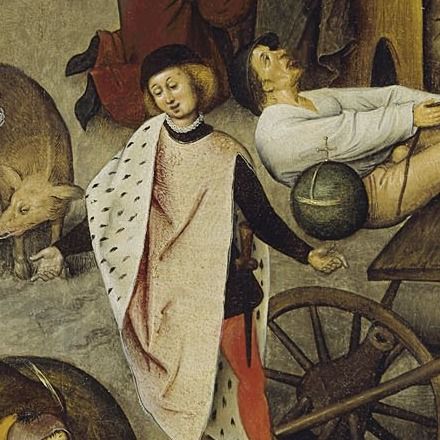
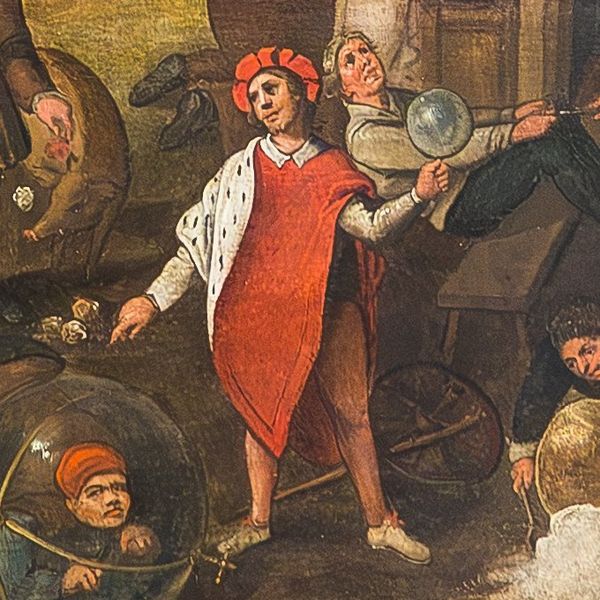
A young man in a red cap with a feather balances a blue globe with a cross on the tip of his thumb. He wears a pink brocade tabard lined with white over dark gray sleeves, and red hose.[2] At his feet, a man :fragment[crawls into a globe]{id="031412fe-f1b8-4cc3-9216-3bc32b57e4f2"}.[2]
Meaning
Everyone dances to his tune: he only has to crook a finger and they come running.[1] It was not said of the rich alone. A play performed in Hasselt in 1565 tells those who live a frivolous life ghy sult vinden dat die werelt op u duymken drayt :audio{src="c6e945df-e3af-434d-9ee7-f81a02bd32bc/2c71db2a-39e1-4059-b475-2b78a84000cb_nl_hasselt_petra.mp3" lang="nl"}, you will find that the world turns on your little thumb.[1]
Did you know?
Duim :audio{src="c6e945df-e3af-434d-9ee7-f81a02bd32bc/2c71db2a-39e1-4059-b475-2b78a84000cb_nl_duim_petra.mp3" lang="nl"}, thumb, was also the name of an iron pin that turns in a ring.[3] The related saying iets draeit up minen dume :audio{src="c6e945df-e3af-434d-9ee7-f81a02bd32bc/2c71db2a-39e1-4059-b475-2b78a84000cb_nl_dume_petra.mp3" lang="nl"}, something turns on my thumb, has been explained from such a pin: to be able to turn a thing as one likes, to be its master.[4] The figure is older than Bruegel: the man who spins the world on his thumb appears in the borders of a prayer book probably made in Ghent in the 1470s.[5]
In other pictures
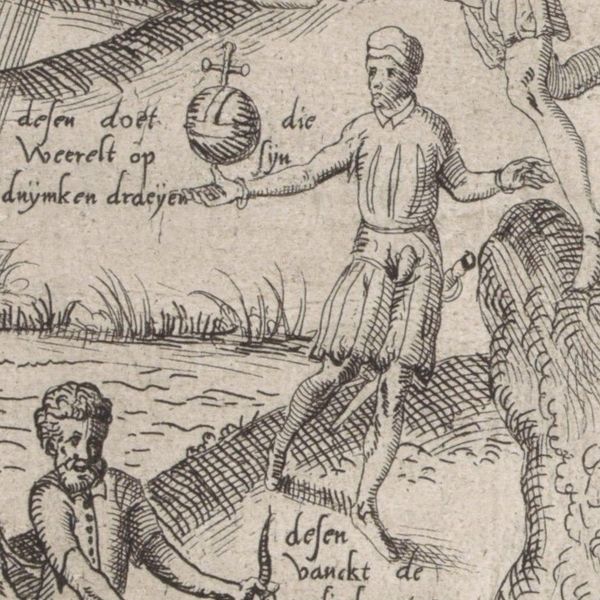
In Frans Hogenberg’s proverb print, which Bruegel most likely worked from, a man spins a globe with a cross on his thumb. The caption reads desen doet die weerelt op syn duymken draeyen :audio{src="c6e945df-e3af-434d-9ee7-f81a02bd32bc/2c71db2a-39e1-4059-b475-2b78a84000cb_nl_hogenberg_petra.mp3" lang="nl"}, this one makes the world turn on his little thumb.[6][7]
::other-pictures
 ::
The painting
::painting-intro ::
::sources
Roger H. Marijnissen, in Seidel and Marijnissen, Bruegel (New York, 1971), 41, no. 29.
Visible in the painting.
Cornelis Kiliaan, Etymologicum teutonicae linguae (Antwerp, 1599), 101, 510.
F. A. Stoett, Nederlandsche spreekwoorden, 4th ed. (Zutphen, 1923–25), no. 509.
Walter S. Gibson, Figures of Speech (Berkeley, 2010), 21.
Walter S. Gibson, Figures of Speech (Berkeley, 2010), 35.
Visible in the print: Frans Hogenberg, Die Blau Huicke, published by 1558; Rijksmuseum, Amsterdam. ::