kind: phrase
Dutch: de huik naar de wind hangen :audio{src="c6e945df-e3af-434d-9ee7-f81a02bd32bc/40bcfb84-b596-451f-881b-7710fdf7fb00_nl_petra.mp3" lang="nl"}[1]
What you see
A man in a red jacket sits astride the top of a brick wall and holds up a dark cloak by its pointed hood. The wind fills it out.[2]
Meaning
To change sides as circumstances make it wise;[1] to be a turncoat.[3] A Dutch dictionary of 1599 explains it as serving the times: turning one’s nature to suit the moment.[4]
Elsewhere
In the sixteenth century French turned the cape to the wind, tourner la cappe au vent :audio{src="c6e945df-e3af-434d-9ee7-f81a02bd32bc/40bcfb84-b596-451f-881b-7710fdf7fb00_fr_tourner_la_cappe.mp3" lang="fr"}.[1]
Did you know?
Medieval Dutch had a name for a man who did this: a wendehoyke :audio{src="c6e945df-e3af-434d-9ee7-f81a02bd32bc/40bcfb84-b596-451f-881b-7710fdf7fb00_nl_wendehoyke_petra.mp3" lang="nl"}, a turn-cloak.[1]
By the 1920s some speakers no longer knew what a huik was. They said de huig naar de wind hangen :audio{src="c6e945df-e3af-434d-9ee7-f81a02bd32bc/40bcfb84-b596-451f-881b-7710fdf7fb00_nl_huig_petra.mp3" lang="nl"} instead, putting in a word they did know: huig, the uvula, the little flap of flesh at the back of the throat. A uvula cannot be hung to the wind, but the misheard form was used all the same.[1]
In other pictures
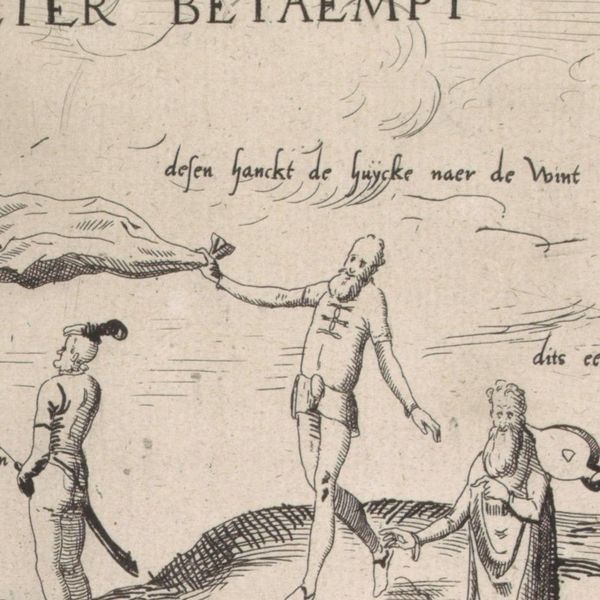
In Frans Hogenberg’s proverb print, which Bruegel most likely worked from, a bearded man stands holding a cloak out into the wind, with the saying as its caption.[5][6]
::other-pictures
 ::
The painting
::painting-intro ::
::sources
F. A. Stoett, Nederlandsche spreekwoorden, 4th ed. (Zutphen, 1923–25), no. 981, quoting Plantin for the French.
Visible in the painting.
Roger H. Marijnissen, in Seidel and Marijnissen, Bruegel (New York, 1971), 42, no. 62.
Cornelis Kiliaan, Etymologicum teutonicae linguae (Antwerp, 1599), 204.
Walter S. Gibson, Figures of Speech (Berkeley, 2010), 35.
Visible in the print: Frans Hogenberg, Die Blau Huicke, published by 1558; Rijksmuseum, Amsterdam. ::