kind: noun
Dutch: een hennetaster :audio{src="c6e945df-e3af-434d-9ee7-f81a02bd32bc/44ebd1d6-5157-466b-b05d-36fea8784893_nl_petra.mp3" lang="nl"}[1]
What you see
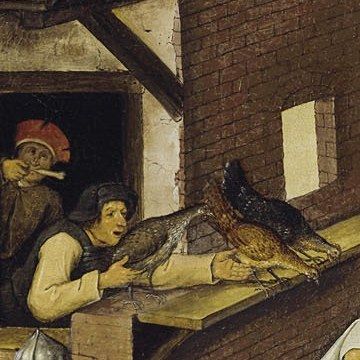
A man in a red cap leans out of a window. With one hand he holds a hen standing on a plank, and with the other he reaches under the tail of a second one. A third, dark hen stands behind them.[2]
Meaning
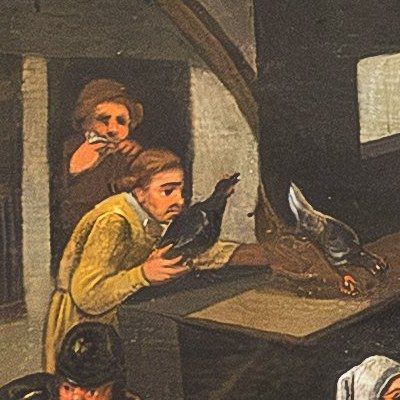
The name comes from feeling a hen to see whether it is going to lay.[1]
A man who meddles in the smallest kitchen matters; a busybody.[3][1]
A skirt-chaser.[1]
Elsewhere
French had un tâte-poule :audio{src="c6e945df-e3af-434d-9ee7-f81a02bd32bc/44ebd1d6-5157-466b-b05d-36fea8784893_fr_tate_poule.mp3" lang="fr"}, a hen-feeler.[3]
In other pictures
::other-pictures
 ::
The painting
::painting-intro ::
::sources
Roger H. Marijnissen, in Seidel and Marijnissen, Bruegel (New York, 1971), 40, no. 14.
Visible in the painting.
F. A. Stoett, Nederlandsche spreekwoorden, 4th ed. (Zutphen, 1923–25), no. 716, quoting Halma. ::