kind: phrase
Dutch: in de eene hand water en in de andere vuur dragen :audio{src="c6e945df-e3af-434d-9ee7-f81a02bd32bc/5db50bca-5ac9-4b09-9ecc-c965afae4a90_nl_petra.mp3" lang="nl"}[1]
What you see
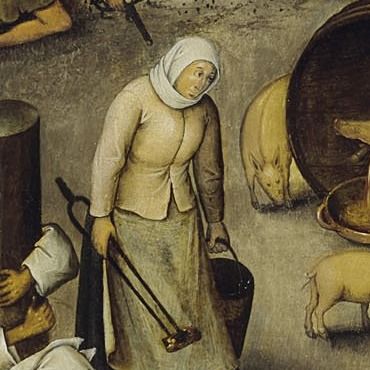
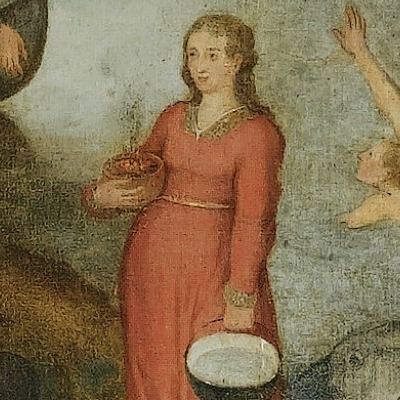
A woman in an apron carries glowing coals in a pair of tongs in one hand and a pail in the other.[2] Beside her, a man hugs a pillar: the :fragment[pillar-biter]{id="0b64b799-0e3b-4326-a315-6fe73ae6e52e"}.[2]
Meaning
To show oneself one way now and another way then; to be two-faced.[1][3] A Latin collection of 1561 says it of people who flatter you to your face and run you down behind your back.[1]
Elsewhere
The saying is ancient: a Greek line quoted by Plutarch speaks of one who carried water in one hand, plotting deceit, and fire in the other.[1] French had porter le feu & eaue :audio{src="c6e945df-e3af-434d-9ee7-f81a02bd32bc/5db50bca-5ac9-4b09-9ecc-c965afae4a90_fr_porter.mp3" lang="fr"}, to carry the fire and water,[4] and in 1546 the English writer John Heywood has “fire in the tone hande, and water in the tother.”[5]
In other pictures
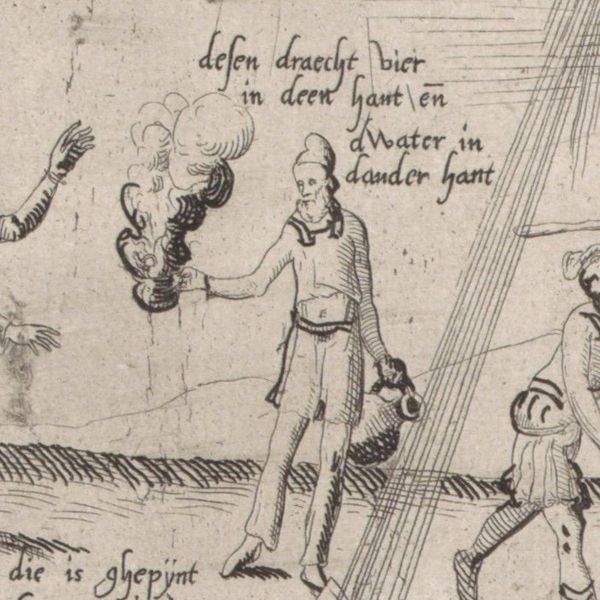
In Frans Hogenberg’s proverb print, which Bruegel most likely worked from, a man holds out something burning in one hand and a jug in the other. The caption reads desen draecht vier in deen hant en dwater in dander hant :audio{src="c6e945df-e3af-434d-9ee7-f81a02bd32bc/5db50bca-5ac9-4b09-9ecc-c965afae4a90_nl_hogenberg_petra.mp3" lang="nl"}, this one carries fire in the one hand and the water in the other.[6][7]
::other-pictures
 ::
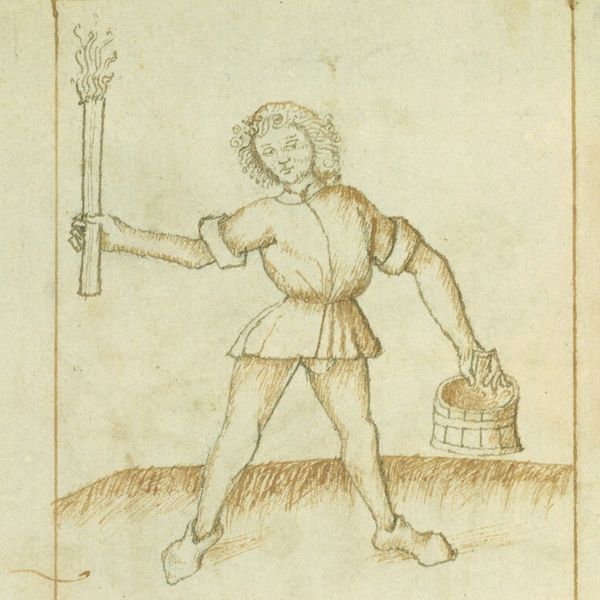
A French manuscript of proverbs in verse, made around 1480, draws a young man with a flaming torch and a bucket. Its verse calls him a fine talker who is found a liar from one day to the next, yet so sweet qu’il porte en l’une main le feu et l’eaue en l’aultre :audio{src="c6e945df-e3af-434d-9ee7-f81a02bd32bc/5db50bca-5ac9-4b09-9ecc-c965afae4a90_fr_walters.mp3" lang="fr"}, that he carries in one hand the fire and the water in the other.[8][9]
::other-pictures
 ::
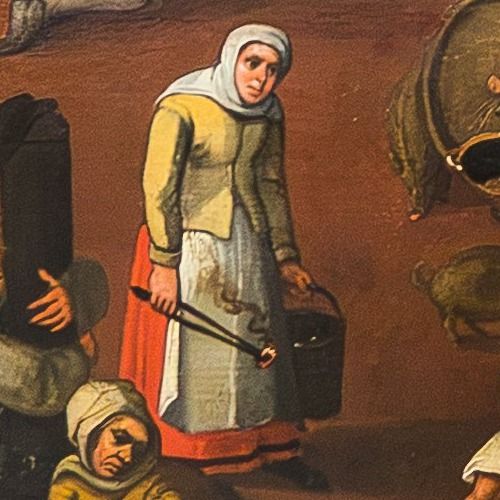
A later copy by a follower of Bruegel moves the woman to the middle of the scene.[10][11]
::other-pictures
 ::
The painting
::painting-intro ::
::sources
F. A. Stoett, Nederlandsche spreekwoorden, 4th ed. (Zutphen, 1923–25), no. 2532.
Visible in the painting.
Roger H. Marijnissen, in Seidel and Marijnissen, Bruegel (New York, 1971), 39, no. 3.
François Goedthals, Les proverbes anciens flamengs et françois (Antwerp, 1568), 62.
Mark A. Meadow, Pieter Bruegel the Elder’s Netherlandish Proverbs and the Practice of Rhetoric (Zwolle, 2002), 63.
Walter S. Gibson, Figures of Speech (Berkeley, 2010), 35.
Visible in the print: Frans Hogenberg, Die Blau Huicke, published by 1558; Rijksmuseum, Amsterdam.
Visible in the manuscript: Proverbes en rimes, French, c. 1480; Walters Art Museum, Baltimore, MS W.313, fol. 66v.
Walter S. Gibson, Figures of Speech (Berkeley, 2010), 22.
Sotheby’s, London, sale L12030 (2012), lot 7, catalogue note.
Visible in the copy: follower of Pieter Bruegel the Elder, sold at Sotheby’s, London, 2012, lot 7 (Wikimedia Commons). ::