kind: phrase
Dutch: met het hoofd tegen de muur lopen :audio{src="c6e945df-e3af-434d-9ee7-f81a02bd32bc/632e95e6-c376-489c-b01c-2bb75bb881d1_nl_petra.mp3" lang="nl"}[1]
What you see
A man in a long white smock, a loose shirt worn over the clothes, with a metal breastplate over it and a white cap, presses his head against the end of a brick wall, a big knife in his hand. His left foot is bare, his right is shod, and a bandage is tied below his right knee.[2] Why he is dressed this way, and why he carries the knife, no one has satisfactorily explained.[3]
Meaning
To pursue the impossible headlong and fail, like a man who tries to run through a wall and only hurts his head.[1][3]
To take a beating.[3]
Elsewhere
English beats its head against the wall; French knocks it, se cogner la tête contre un mur :audio{src="c6e945df-e3af-434d-9ee7-f81a02bd32bc/632e95e6-c376-489c-b01c-2bb75bb881d1_fr_se_cogner_la_tete.mp3" lang="fr"}.[1]
Did you know?
The saying was already old when Bruegel painted it. A Dutch poem of the Middle Ages warns: die met syn hooft wil dor den muer, heeft dicke aventure suer :audio{src="c6e945df-e3af-434d-9ee7-f81a02bd32bc/632e95e6-c376-489c-b01c-2bb75bb881d1_nl_grimbergen_petra.mp3" lang="nl"}, whoever wants to go through the wall with his head often has a sour adventure.[1]
In other pictures
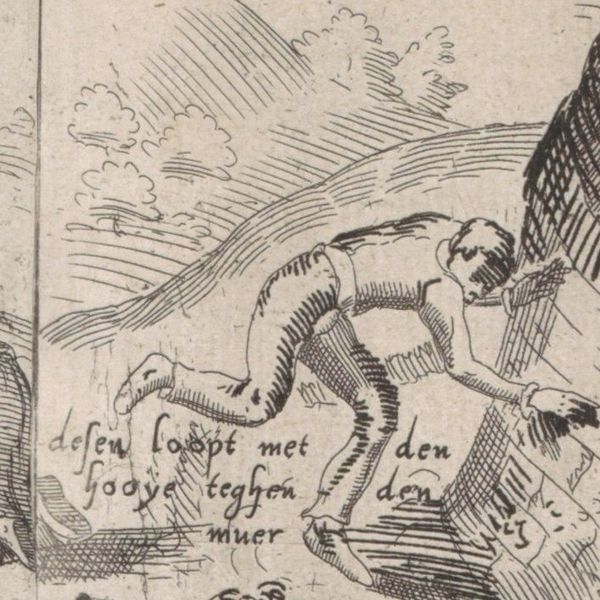
In Frans Hogenberg’s proverb print, which Bruegel most likely worked from, the man charges at the wall headfirst.[4][5]
::other-pictures
 ::
The painting
::painting-intro ::
::sources
F. A. Stoett, Nederlandsche spreekwoorden, 4th ed. (Zutphen, 1923–25), no. 949, quoting Die Grimbergsche oorlog for the poem.
Visible in the painting.
Roger H. Marijnissen, in Seidel and Marijnissen, Bruegel (New York, 1971), 40, no. 8.
Walter S. Gibson, Figures of Speech (Berkeley, 2010), 35.
Visible in the print: Frans Hogenberg, Die Blau Huicke, published by 1558; Rijksmuseum, Amsterdam. ::