kind: phrase
Dutch: twee hoofden in eenen caproen :audio{src="c6e945df-e3af-434d-9ee7-f81a02bd32bc/67531737-d6df-48a2-8c89-fd64a9e4a2a9_nl_petra.mp3" lang="nl"}[1]
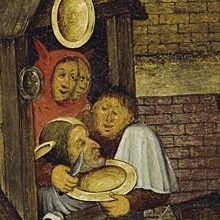
What you see
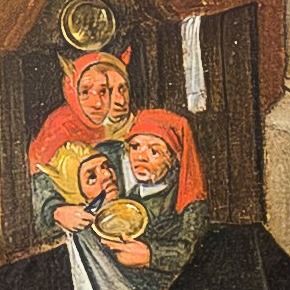
At a window, two faces look out from under one dark hood.[2] In the same window, a :fragment[fool is shaved]{id="72b0377e-26db-4ea2-af39-89e1acdbab2a"}.[3]
Meaning
Two people who think alike and always agree.[4]
Elsewhere
A Flemish–French book of 1568 gives the French deux testes en vn chaperon :audio{src="c6e945df-e3af-434d-9ee7-f81a02bd32bc/67531737-d6df-48a2-8c89-fd64a9e4a2a9_fr_testes.mp3" lang="fr"}, two heads in one hood.[1]
In other pictures
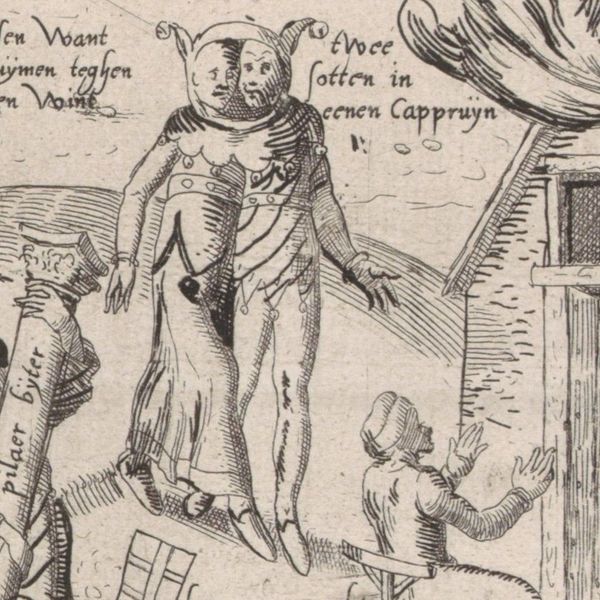
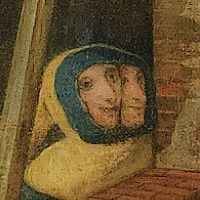
In Frans Hogenberg’s proverb print, which Bruegel most likely worked from, the two are fools: they share a fool’s hood with long ears, and the caption reads twee sotten in eenen cappruyn :audio{src="c6e945df-e3af-434d-9ee7-f81a02bd32bc/67531737-d6df-48a2-8c89-fd64a9e4a2a9_nl_hogenberg_petra.mp3" lang="nl"}, two fools in one hood.[5][6] Bruegel’s hood is plain.[2]
::other-pictures
 ::
The painting
::painting-intro ::
::sources
François Goedthals, Les proverbes anciens flamengs et françois (Antwerp, 1568), 36.
Visible in the painting.
Margaret A. Sullivan, “Bruegel’s Proverbs: Art and Audience in the Northern Renaissance,” The Art Bulletin 73 (1991), 455.
Roger H. Marijnissen, in Seidel and Marijnissen, Bruegel (New York, 1971), 42, no. 52.
Walter S. Gibson, Figures of Speech (Berkeley, 2010), 35.
Visible in the print: Frans Hogenberg, Die Blau Huicke, published by 1558; Rijksmuseum, Amsterdam. ::