kind: saying
Dutch: hij geeft er niet om wiens huis in lichtelaaie staat, als hij zich maar aan de gloed kan warmen :audio{src="c6e945df-e3af-434d-9ee7-f81a02bd32bc/6faf5a16-47c1-4d39-8847-f2f9bdce7b46_nl_petra.mp3" lang="nl"}[1]
Word for word: he gives there not about whose house in blaze stands, if he himself only at the glow can warm.
What you see
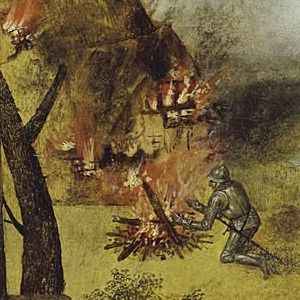
A man in a helmet, a sword at his side, kneels barefoot and holds his hands to a great blaze of burning timbers.[2]
Meaning
He thinks only of himself: what others lose does not matter to him, as long as he gains by it.[1][3]
Disputed
The same picture fits a kinder saying: als thuys berrent, aen de colen waermen :audio{src="c6e945df-e3af-434d-9ee7-f81a02bd32bc/6faf5a16-47c1-4d39-8847-f2f9bdce7b46_nl_goedthals_petra.mp3" lang="nl"}, when the house burns, warm oneself at the coals, meaning that nothing is so bad that no good comes of it.[1][4] That has been thought too hopeful for Bruegel’s time,[1] but a Flemish–French book of 1568 gives both meanings: ne chaloir, a qui brusle la maison, mais qu’on se chauffe bien :audio{src="c6e945df-e3af-434d-9ee7-f81a02bd32bc/6faf5a16-47c1-4d39-8847-f2f9bdce7b46_fr_chaloir.mp3" lang="fr"}, never mind whose house burns as long as one warms oneself well, and il n’est mal, dont bien ne vienne :audio{src="c6e945df-e3af-434d-9ee7-f81a02bd32bc/6faf5a16-47c1-4d39-8847-f2f9bdce7b46_fr_mal.mp3" lang="fr"}, there is no ill from which no good comes.[4]
Did you know?
A play performed in Hasselt in 1607 has the line ons en raect wiens huys dat bernt achermen, te minsten dat wy ons aen die coelen wermen :audio{src="c6e945df-e3af-434d-9ee7-f81a02bd32bc/6faf5a16-47c1-4d39-8847-f2f9bdce7b46_nl_hasselt_petra.mp3" lang="nl"}: we don’t care whose house burns down, so long as we can warm ourselves at the coals.[1]
In other pictures
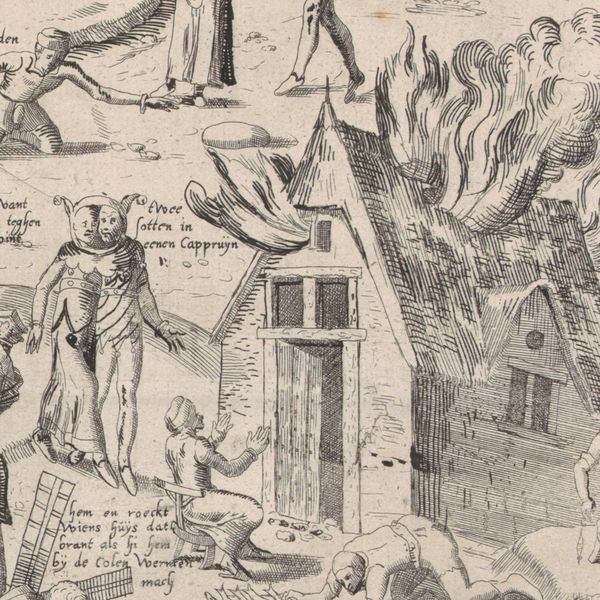
In Frans Hogenberg’s proverb print, which Bruegel most likely worked from, a man sits with his hands raised beside a burning house. The caption reads hem en roeckt wiens huys dat brant als hi hem by de colen wermen mach :audio{src="c6e945df-e3af-434d-9ee7-f81a02bd32bc/6faf5a16-47c1-4d39-8847-f2f9bdce7b46_nl_hogenberg_petra.mp3" lang="nl"}, he does not care whose house burns if he can warm himself at the coals.[5][6]
::other-pictures
 ::
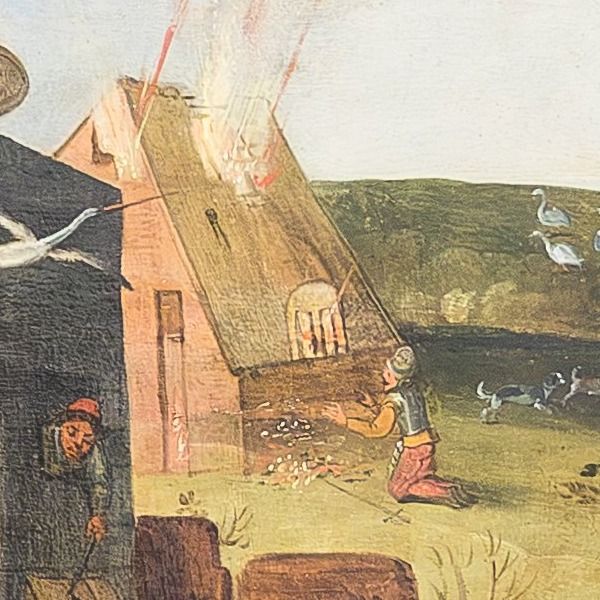
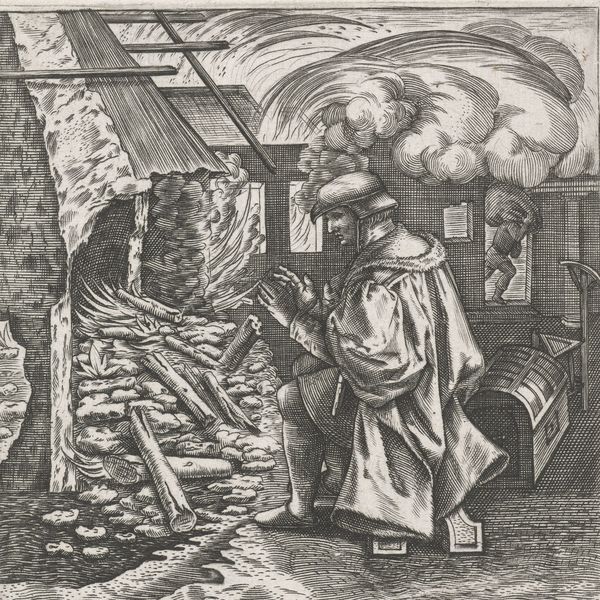
An engraving from a series of twelve proverbs, attributed to Jan Wierix, shows the man too. Its verse says he cares not whose house burns, so long as he can warm himself at the fire.[3]
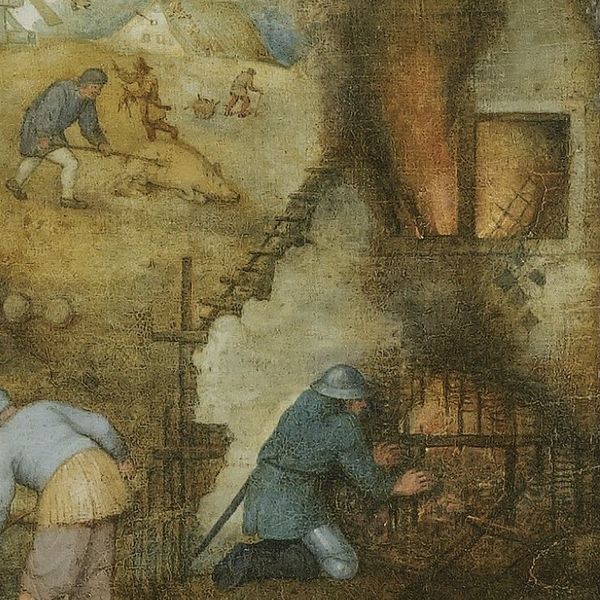
A print published in Frankfurt in 1596 shows a man in a fur-trimmed coat warming his hands at the blaze, while behind him another runs off with a load on his back.[7] The Dutch verse that goes with it in the book includes the lines Hem en ruchs wiens huys dat brant / Als hy hem mach by de colen wermen :audio{src="c6e945df-e3af-434d-9ee7-f81a02bd32bc/6faf5a16-47c1-4d39-8847-f2f9bdce7b46_nl_debry_petra.mp3" lang="nl"}: he does not care whose house burns, if he can warm himself at the coals.[8]
::other-pictures
 ::
The painting
::painting-intro ::
::sources
Roger H. Marijnissen, in Seidel and Marijnissen, Bruegel (New York, 1971), 42–43, no. 76.
Visible in the painting.
Walter S. Gibson, Figures of Speech (Berkeley, 2010), 90–91.
François Goedthals, Les proverbes anciens flamengs et françois (Antwerp, 1568), 59.
Walter S. Gibson, Figures of Speech (Berkeley, 2010), 35.
Visible in the print: Frans Hogenberg, Die Blau Huicke, published by 1558; Rijksmuseum, Amsterdam.
Visible in the print: Johann Theodor de Bry, Emblemata Saecularia (Frankfurt, 1596), no. 39; Rijksmuseum, Amsterdam (Wikimedia Commons).
Rijksmuseum, Amsterdam, RP-P-BI-5225, catalogue record. ::