kind: phrase
Dutch: achter het net visschen :audio{src="c6e945df-e3af-434d-9ee7-f81a02bd32bc/787c6d94-87d4-4a17-ae8f-0a7bb9044242_nl_petra.mp3" lang="nl"}[1]
What you see
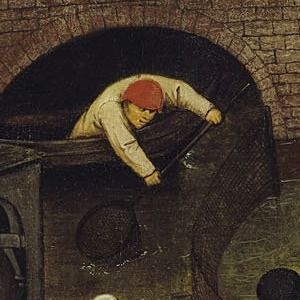
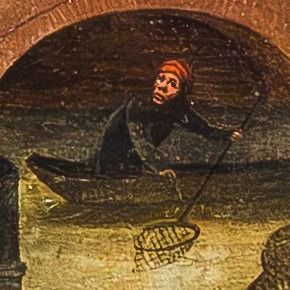
Under a dark archway, a man leans over the side of a boat with a scoop net on a long handle. Beside him a big net hangs from the arch into the water, and fish leap by it.[2]
Meaning
To come too late, when someone else has already taken the chance, and so to come away empty-handed.[1][3] Literally, to fish where others have already dragged their nets, so that nothing is left to catch.[1]
Elsewhere
In 1546 the English writer John Heywood has “it is yll fishing behind the net.”[4]
Did you know?
A Dutch book of 1606 puts it in verse: achter ’t net te visschen, is kleyn bescheedt: want daer en is doch niet te halen :audio{src="c6e945df-e3af-434d-9ee7-f81a02bd32bc/787c6d94-87d4-4a17-ae8f-0a7bb9044242_nl_idinau_petra.mp3" lang="nl"}, to fish behind the net is a small share, for there is nothing to be had there.[1]
In other pictures
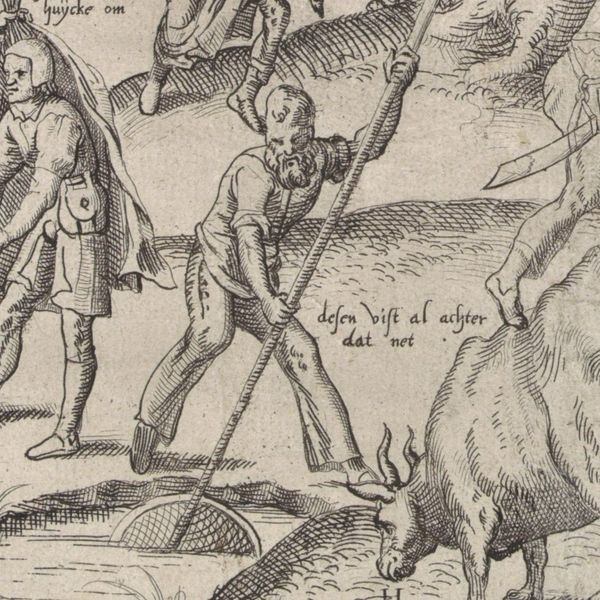
In Frans Hogenberg’s proverb print, which Bruegel most likely worked from, a man fishes with a net on a long pole. The caption reads desen vist al achter dat net :audio{src="c6e945df-e3af-434d-9ee7-f81a02bd32bc/787c6d94-87d4-4a17-ae8f-0a7bb9044242_nl_hogenberg_petra.mp3" lang="nl"}, this one fishes behind the net.[5][6]
::other-pictures
 ::
The painting
::painting-intro ::
::sources
F. A. Stoett, Nederlandsche spreekwoorden, 4th ed. (Zutphen, 1923–25), no. 1615.
Visible in the painting.
Roger H. Marijnissen, in Seidel and Marijnissen, Bruegel (New York, 1971), 42, no. 54.
Mark A. Meadow, Pieter Bruegel the Elder’s Netherlandish Proverbs and the Practice of Rhetoric (Zwolle, 2002), 63.
Walter S. Gibson, Figures of Speech (Berkeley, 2010), 35.
Visible in the print: Frans Hogenberg, Die Blau Huicke, published by 1558; Rijksmuseum, Amsterdam. ::