kind: saying
Dutch: de zeug trekt de tap uit :audio{src="c6e945df-e3af-434d-9ee7-f81a02bd32bc/7de24503-d930-4945-a709-1f895faa76f2_nl_petra.mp3" lang="nl"}[1]
What you see
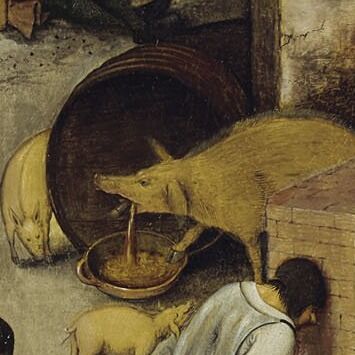
A sow pulls a wooden tap out of the end of a barrel with her teeth, and the drink runs into an earthenware basin. A funnel stands upside down on the barrel; piglets are around her.[2]
Meaning
Said of an innkeeper who doesn’t keep a strict eye on things, so that everybody takes advantage of him.[1]
Did you know?
An Antwerp edition of Erasmus’s proverbs, printed in 1545 with Dutch sayings added, already has de soch heuet den tap wt getrocken :audio{src="c6e945df-e3af-434d-9ee7-f81a02bd32bc/7de24503-d930-4945-a709-1f895faa76f2_nl_servilius_petra.mp3" lang="nl"}, the sow has pulled out the tap.[3] In other collections the sow runs off with the tap, de sogh gaet met den tap loopen :audio{src="c6e945df-e3af-434d-9ee7-f81a02bd32bc/7de24503-d930-4945-a709-1f895faa76f2_nl_loopen_petra.mp3" lang="nl"},[4] and that is said of an innkeeper whose business is going badly.[5] An eighteenth-century collector, who says it of tapped-out tavern keepers, explains the joke: the slops in empty barrels go to the pigs once the tap is pulled out.[6]
In other pictures
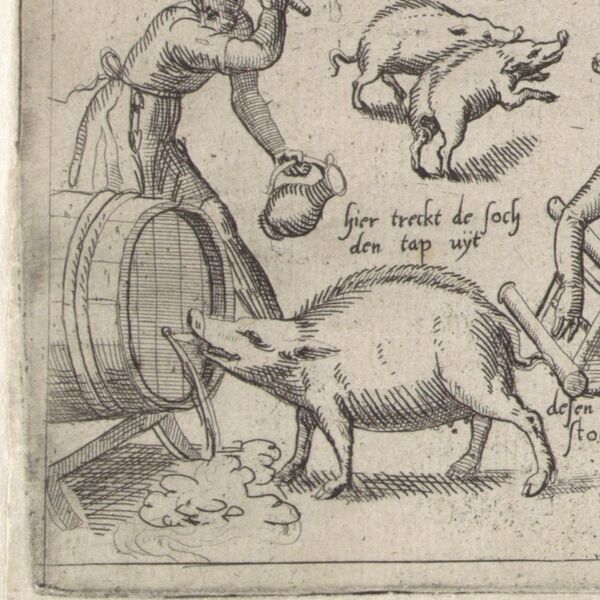
In Frans Hogenberg’s proverb print, which Bruegel most likely worked from, a sow pulls the tap from a barrel. The caption reads hier treckt de soch den tap uyt :audio{src="c6e945df-e3af-434d-9ee7-f81a02bd32bc/7de24503-d930-4945-a709-1f895faa76f2_nl_hogenberg_petra.mp3" lang="nl"}, here the sow pulls the tap out.[7][8]
::other-pictures
 ::
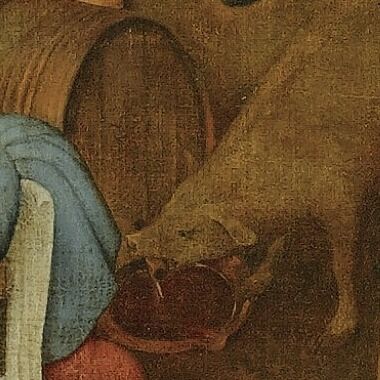
In a copy by a follower of Bruegel, no tap shows; the sow has her snout in the basin.[9]
::other-pictures
 ::
The painting
::painting-intro ::
::sources
Roger H. Marijnissen, in Seidel and Marijnissen, Bruegel (New York, 1971), 39, no. 7.
Visible in the painting.
Joannes Servilius, Dutch sayings in Erasmus, Adagiorum epitome (Antwerp, 1545), 235, quoted in P. J. Harrebomée, Spreekwoordenboek der Nederlandsche taal (Utrecht, 1858–70), vol. 3, Appendix, note on vol. 2, p. 325.
Donaes Idinau, Lot van wijsheyd ende goed geluck (Antwerp, 1606), 27, quoted in P. J. Harrebomée, Spreekwoordenboek der Nederlandsche taal (Utrecht, 1858–70), vol. 3, Appendix, note on vol. 2, p. 325.
P. J. Harrebomée, Spreekwoordenboek der Nederlandsche taal (Utrecht, 1858–70), vol. 2, 325.
Carolus Tuinman, De oorsprong en uitlegging van dagelyks gebruikte Nederduitsche spreekwoorden, vol. 2 (1727), 52.
Walter S. Gibson, Figures of Speech (Berkeley, 2010), 35.
Visible in the print: Frans Hogenberg, Die Blau Huicke, published by 1558; Rijksmuseum, Amsterdam.
Visible in the copy: follower of Pieter Bruegel the Elder, sold at Sotheby’s, London, 2012, lot 7 (Wikimedia Commons). ::