kind: saying
Dutch: daar hangt de schaar uit :audio{src="c6e945df-e3af-434d-9ee7-f81a02bd32bc/8208b979-1f88-4ef6-94f8-f4489213ca16_nl_petra.mp3" lang="nl"}[1][2]
What you see
A pair of shears hangs from an iron rod on a wooden post, like a sign.[3][2]
Meaning
It is expensive there; there you get fleeced.[1][2] It was said of inns and shops.[4]
Did you know?
Shops hung out a sign of their trade: a trowel at the mason’s, a last at the shoemaker’s, a pair of scissors, often gilded, at the tailor’s. Tailors were known for keeping back part of the cloth their customers gave them, which was called :fragment[pulling the cloth through the eye of the scissors]{id="ac00455a-0c3a-4186-8636-e9517c4014f2"},[5] and so their sign came to mean a place where you are cut. Innkeepers had no better name, so it was said of inns too.[1][6] An eighteenth-century collector explained it another way: the innkeeper shears his guests like sheep, of the wool in their purses.[7] Around 1920, seaside villas in West Flanders bore the words t’ is hier in de scheer :audio{src="c6e945df-e3af-434d-9ee7-f81a02bd32bc/8208b979-1f88-4ef6-94f8-f4489213ca16_nl_villa_petra.mp3" lang="nl"}, it is here in the scissors, used instead to mean good cheer among friends.[1]
In other pictures
::other-pictures
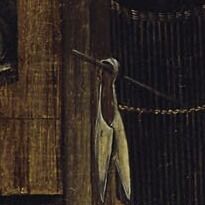
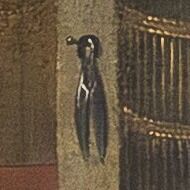 ::
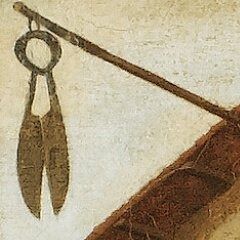
In a copy by a follower of Bruegel, the shears hang from a long pole out of a gable.[8]
::other-pictures
 ::
The painting
::painting-intro ::
::sources
F. A. Stoett, Nederlandsche spreekwoorden, 4th ed. (Zutphen, 1923–25), no. 1978.
Roger H. Marijnissen, in Seidel and Marijnissen, Bruegel (New York, 1971), 40, no. 12.
Visible in the painting.
Carolus Tuinman, De oorsprong en uitlegging van dagelyks gebruikte Nederduitsche spreekwoorden, vol. 2 (1727), 47.
F. A. Stoett, Nederlandsche spreekwoorden, 4th ed. (Zutphen, 1923–25), no. 1696.
F. A. Stoett, Nederlandsche spreekwoorden, 4th ed. (Zutphen, 1923–25), no. 32.
Carolus Tuinman, De oorsprong en uitlegging van dagelyks gebruikte Nederduitsche spreekwoorden, vol. 1 (1726), 73.
Visible in the copy: follower of Pieter Bruegel the Elder, sold at Sotheby’s, London, 2012, lot 7 (Wikimedia Commons). ::