kind: saying
Dutch: grote vissen eten de kleine :audio{src="c6e945df-e3af-434d-9ee7-f81a02bd32bc/940d613e-8dff-4e9b-aba1-135de7de304f_nl_petra.mp3" lang="nl"}[1]
What you see
A big pale fish rears out of dark water, its mouth full of sharp teeth, with a smaller gray fish halfway down its throat. Only the small one’s tail still sticks out.[2]
Meaning
The powerful devour the weak. Around 1200 the preacher Stephen Langton already put it this way: in the sea of this world, “the greater fish (princes and nobles) devour lesser folk and digest their wealth.”[3]
Elsewhere
French had it in the same words in 1568: les grands poissons mangent les petits :audio{src="c6e945df-e3af-434d-9ee7-f81a02bd32bc/940d613e-8dff-4e9b-aba1-135de7de304f_fr_les_grands_poissons.mp3" lang="fr"}.[4]
Did you know?
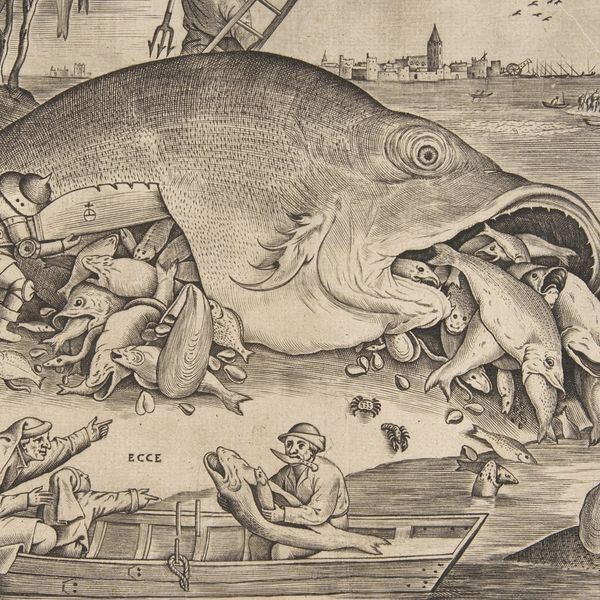
Three years before this painting, Bruegel drew the proverb as a whole picture of its own. When the drawing was engraved and published in 1557, the print named Hieronymus Bosch as its inventor, although the drawing carries Bruegel’s name and the date 1556.[3][5]
In other pictures
In the print, a giant fish lies stranded on the shore, cut open, and smaller fish spill out of it with still smaller fish in their mouths.[6]
::other-pictures
 ::
The painting
::painting-intro ::
::sources
Roger H. Marijnissen, in Seidel and Marijnissen, Bruegel (New York, 1971), 42, no. 65.
Visible in the painting.
Margaret A. Sullivan, “Bruegel’s Proverbs: Art and Audience in the Northern Renaissance,” The Art Bulletin 73 (1991), 441.
François Goedthals, Les proverbes anciens flamengs et françois (Antwerp, 1568), 38.
Walter S. Gibson, Figures of Speech (Berkeley, 2010), 67.
Visible in the print: Pieter van der Heyden after Pieter Bruegel the Elder, Big Fish Eat Little Fish, 1557; The Metropolitan Museum of Art, New York (Wikimedia Commons). ::