kind: saying
Dutch: hij want pluimen in de wind :audio{src="c6e945df-e3af-434d-9ee7-f81a02bd32bc/9928075f-648c-46d6-ae5e-2a73830479f8_nl_petra.mp3" lang="nl"}[1]
What you see
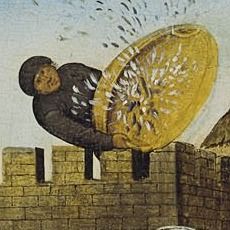
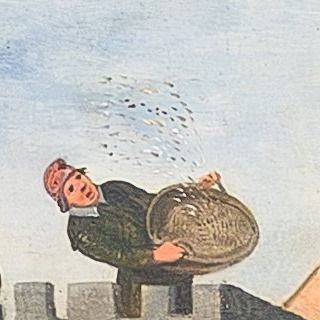
Leaning over a wall, a man tips out a big basket, and the wind carries the feathers off into the air.[2]
Meaning
To set about a job rashly, without method.[1]
To waste one’s work.[3]
Did you know?
To winnow, wannen :audio{src="c6e945df-e3af-434d-9ee7-f81a02bd32bc/9928075f-648c-46d6-ae5e-2a73830479f8_nl_wannen_petra.mp3" lang="nl"}, is to shake grain in a winnowing basket so that the breeze carries off the husks.[4]
In other pictures
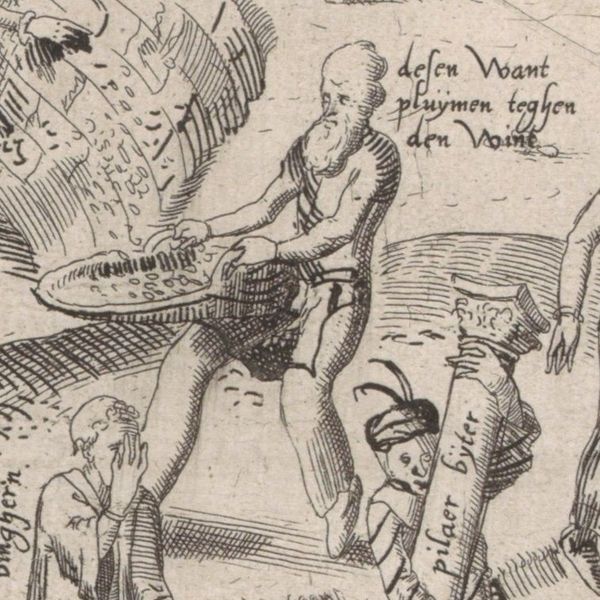
In Frans Hogenberg’s proverb print, which Bruegel most likely worked from, the caption beside an old man reads desen want pluymen teghen den wint :audio{src="c6e945df-e3af-434d-9ee7-f81a02bd32bc/9928075f-648c-46d6-ae5e-2a73830479f8_nl_hogenberg_petra.mp3" lang="nl"}, this one winnows feathers against the wind.[5][6]
::other-pictures
 ::
The painting
::painting-intro ::
::sources
Roger H. Marijnissen, in Seidel and Marijnissen, Bruegel (New York, 1971), 42, no. 64.
Visible in the painting.
Mark A. Meadow, Pieter Bruegel the Elder’s Netherlandish Proverbs and the Practice of Rhetoric (Zwolle, 2002), 38.
Cornelis Kiliaan, Etymologicum teutonicae linguae (Antwerp, 1599), 653.
Walter S. Gibson, Figures of Speech (Berkeley, 2010), 35.
Visible in the print: Frans Hogenberg, Die Blau Huicke, published by 1558; Rijksmuseum, Amsterdam. ::