kind: saying
Dutch: daar zijn de daken met vladen gedekt :audio{src="c6e945df-e3af-434d-9ee7-f81a02bd32bc/a5bc9a20-66ce-469c-ad5b-59ce554997b6_nl_petra.mp3" lang="nl"}[1]
What you see
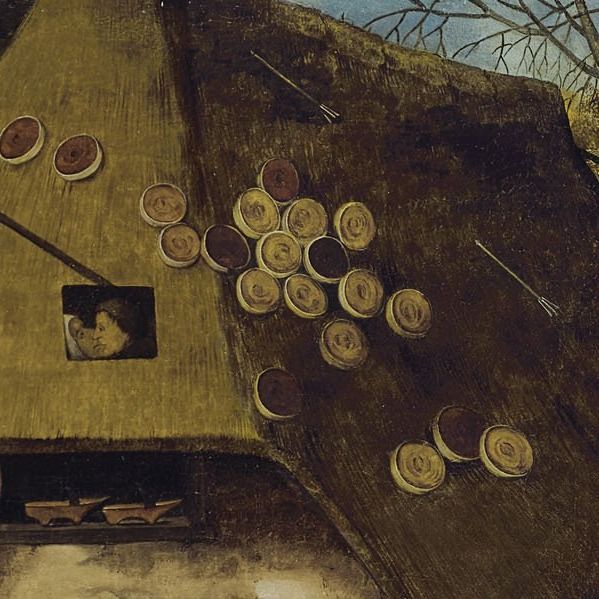
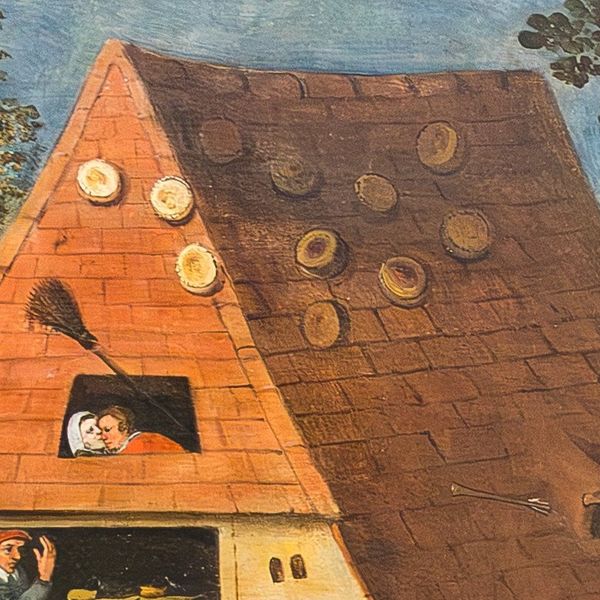
The roof of a house at the upper left is laid with round tarts among its tiles, some golden, some dark. A man with a crossbow :fragment[shoots along the same roof]{id="e1a23ef2-d399-4434-8105-4e682b744091"}.[2]
Meaning
That is a land of plenty, the Land of Cockaigne.[1]
Did you know?
Roofs like this belong to Cockaigne, an imaginary land of plenty where food is there for the taking and nobody has to work for it.[1][3] Bruegel did not invent them: a Dutch description of Cockaigne printed in 1546 already has roofs tiled with cakes and pies, a fence of sausages and a river of milk. Its author was no admirer of the place. In his telling, Cockaigne was discovered by good-for-nothings and is crowded with scoundrels.[3]
In other pictures
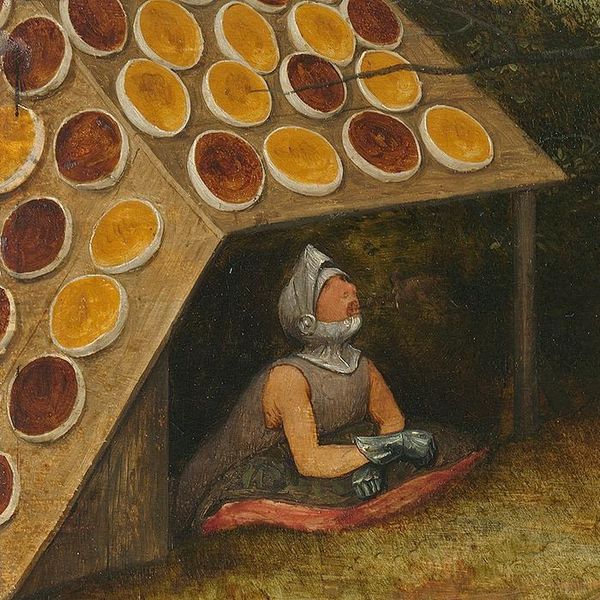
Eight years after the Proverbs, Bruegel painted the Land of Cockaigne itself, and a roof of tarts is in it again, sheltering a knight.[3][4]
::other-pictures
 ::
The painting
::painting-intro ::
::sources
Roger H. Marijnissen, in Seidel and Marijnissen, Bruegel (New York, 1971), 41, no. 50.
Visible in the painting.
Roger H. Marijnissen, in Seidel and Marijnissen, Bruegel (New York, 1971), 26.
Visible in the painting: Pieter Bruegel the Elder, The Land of Cockaigne, 1567; Alte Pinakothek, Munich (Wikimedia Commons). ::