kind: phrase
Dutch: een oog in het zeil houden :audio{src="c6e945df-e3af-434d-9ee7-f81a02bd32bc/ad11bfe6-6179-4a18-82cd-c6ec2d347dd0_nl_petra.mp3" lang="nl"}[1]
What you see
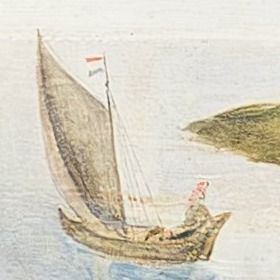
Far out at sea, a man sits in a small boat with an eye painted on its sail.[2]
Meaning
To stay on one’s guard, to keep a watchful eye.[1][3] A Dutch book of 1681 on words and sayings taken from seafaring calls it “the work of a good seaman, to be constantly on his guard.”[1]
Elsewhere
A Flemish–French book of 1568 gives it the French l’œil faict le guet :audio{src="c6e945df-e3af-434d-9ee7-f81a02bd32bc/ad11bfe6-6179-4a18-82cd-c6ec2d347dd0_fr_guet.mp3" lang="fr"}, the eye keeps watch.[4]
Did you know?
The expression is old: it turns up in late medieval chronicles, and Frisian and Low German have it too.[1]
In other pictures
In a later copy of the painting, now in Aachen, no eye can be seen on the sail.[5]
::other-pictures
 ::
The painting
::painting-intro ::
::sources
F. A. Stoett, Nederlandsche spreekwoorden, 4th ed. (Zutphen, 1923–25), no. 1682.
Visible in the painting.
Roger H. Marijnissen, in Seidel and Marijnissen, Bruegel (New York, 1971), 43, no. 81.
François Goedthals, Les proverbes anciens flamengs et françois (Antwerp, 1568), 57.
Visible in the copy: Suermondt-Ludwig-Museum, Aachen (Wikimedia Commons). ::