kind: phrase
Dutch: door de mand vallen :audio{src="c6e945df-e3af-434d-9ee7-f81a02bd32bc/bc9da5f4-1c4f-4adf-b159-4483cd0f7a69_nl_petra.mp3" lang="nl"}[1]
What you see
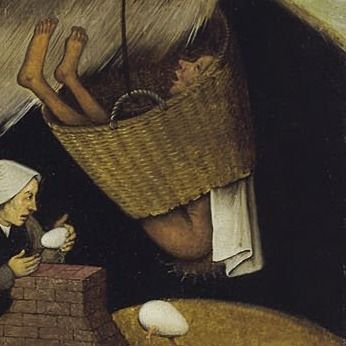
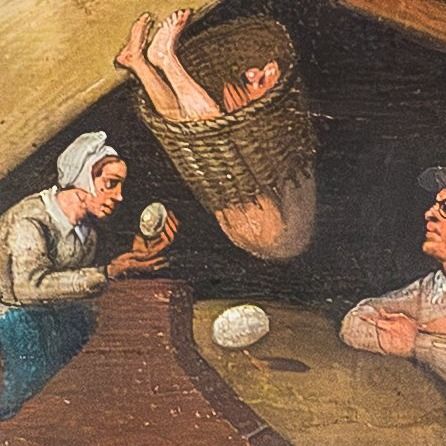
A man hangs in a basket on a rope, bare legs in the air. His backside has broken through the bottom of the basket.[2]
Meaning
To be caught out: said of someone who first denied a thing and then had to admit it.[1] To fail, to come to grief; to be turned down.[3]
Did you know?
Nobody knows for sure where the saying comes from, and there are two stories. In one, it was a punishment: the condemned man was hung in a basket over the water with a knife and pelted with filth until he cut the rope and dropped into the canal. In the other, a girl sent a suitor she did not want a basket with no bottom.[1] Bruegel’s basket hangs from a rope, as in the first story.[2]
In other pictures
::other-pictures
 ::
The painting
::painting-intro ::
::sources
F. A. Stoett, Nederlandsche spreekwoorden, 4th ed. (Zutphen, 1923–25), no. 1473.
Visible in the painting.
Roger H. Marijnissen, in Seidel and Marijnissen, Bruegel (New York, 1971), 41, no. 39. ::