kind: phrase
Dutch: de duivel een kaars ontsteken :audio{src="c6e945df-e3af-434d-9ee7-f81a02bd32bc/d5230fd6-bb82-4752-a2bf-5fce243d2792_nl_petra.mp3" lang="nl"}[1]
What you see
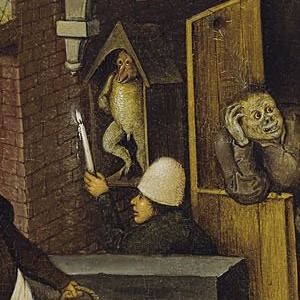
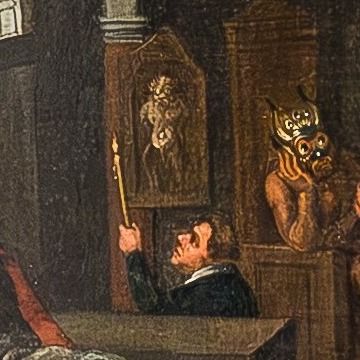
A man in a red cap holds up a lit candle to a devil with a furry body. The devil sits in a narrow, speckled case with a pointed top, open on one side, and one candle already burns in front of him. Next to them, another devil hears a :fragment[man’s confession]{id="e4f915ad-c1d7-4216-99be-b8c932d57565"}.[2]
Meaning
To flatter people, even ones who cannot be trusted, to win their help or support.[1]
Elsewhere
English had the same picture: to hold a candle to the devil, meaning to help or put up with what is wrong.[3]
Did you know?
An English dictionary of the 1890s explained the phrase by the custom of burning candles before the image of a favorite saint.[3] Bruegel’s man lights his candles to the devil instead.[2]
In other pictures
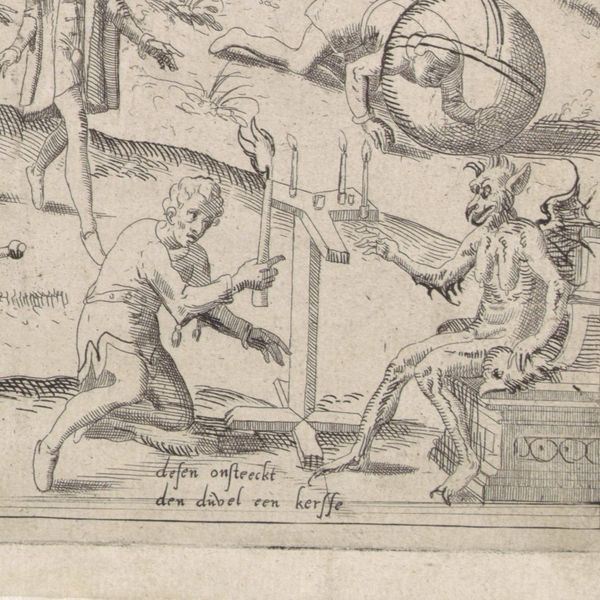
In Frans Hogenberg’s proverb print, which Bruegel most likely worked from, a man kneels with a burning candle by a stand full of candles and points to a devil seated on a pedestal. The caption reads desen onsteeckt den duvel een kersse :audio{src="c6e945df-e3af-434d-9ee7-f81a02bd32bc/d5230fd6-bb82-4752-a2bf-5fce243d2792_nl_hogenberg_petra.mp3" lang="nl"}, this one lights the devil a candle.[4][5]
::other-pictures
 ::
The painting
::painting-intro ::
::sources
Roger H. Marijnissen, in Seidel and Marijnissen, Bruegel (New York, 1971), 40, no. 17.
Visible in the painting.
E. Cobham Brewer, Dictionary of Phrase and Fable, rev. ed. (London, 1895), s.v. “Candle.”
Walter S. Gibson, Figures of Speech (Berkeley, 2010), 35.
Visible in the print: Frans Hogenberg, Die Blau Huicke, published by 1558; Rijksmuseum, Amsterdam. ::