kind: phrase
Dutch: van de os op de ezel vallen :audio{src="c6e945df-e3af-434d-9ee7-f81a02bd32bc/dd3e877d-1589-47d3-9101-2f9818b586be_nl_petra.mp3" lang="nl"}[1]
What you see
A man in a white shirt tumbles headfirst from a brown, horned ox onto a gray donkey, his legs in the air.[2]
Meaning
To fall on bad times.[1][3]
To jump from one subject to another.[1][3]
Elsewhere
English says it without the animals: from riches to rags.[1]
Did you know?
The two senses have two sources. The fall goes back to a Greek phrase, “from horses to donkeys,” found in the sixth-century writer Procopius and taken over into Latin. The jump comes from French, which leapt du coq à l’âne :audio{src="c6e945df-e3af-434d-9ee7-f81a02bd32bc/dd3e877d-1589-47d3-9101-2f9818b586be_fr_du_coq_a_lane.mp3" lang="fr"}, from the rooster to the donkey.[3] Dutch used both verbs, jump and fall; Bruegel painted the fall.[1][2]
In other pictures
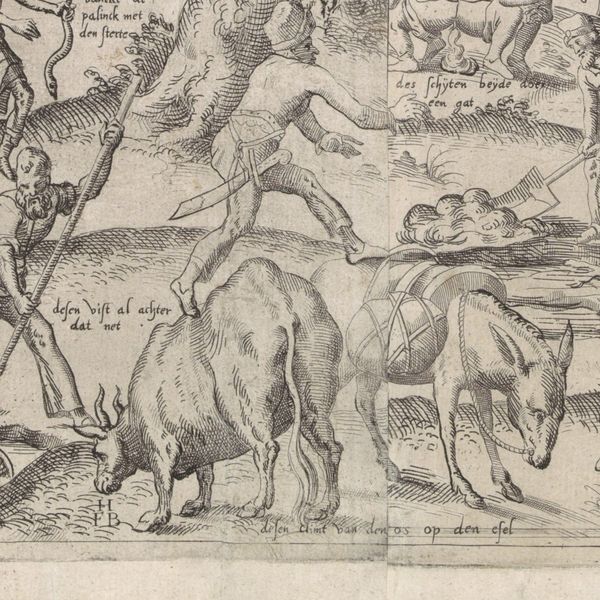
In Frans Hogenberg’s proverb print, which Bruegel most likely worked from, the man steps from the ox’s back toward a loaded donkey, and the caption says he climbs.[4][5]
::other-pictures
 ::
The painting
::painting-intro ::
::sources
Roger H. Marijnissen, in Seidel and Marijnissen, Bruegel (New York, 1971), 42, no. 57.
Visible in the painting.
F. A. Stoett, Nederlandsche spreekwoorden, 4th ed. (Zutphen, 1923–25), no. 1733.
Walter S. Gibson, Figures of Speech (Berkeley, 2010), 35.
Visible in the print: Frans Hogenberg, Die Blau Huicke, published by 1558; Rijksmuseum, Amsterdam. ::