kind: saying
Dutch: de ene scheert schapen, de andere varkens :audio{src="c6e945df-e3af-434d-9ee7-f81a02bd32bc/e2129f46-8ac3-48b0-aefb-975df9413a8a_nl_petra.mp3" lang="nl"}[1]
What you see
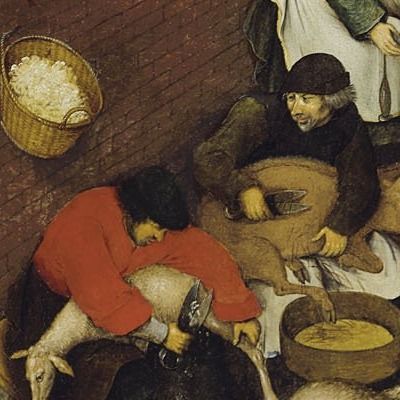
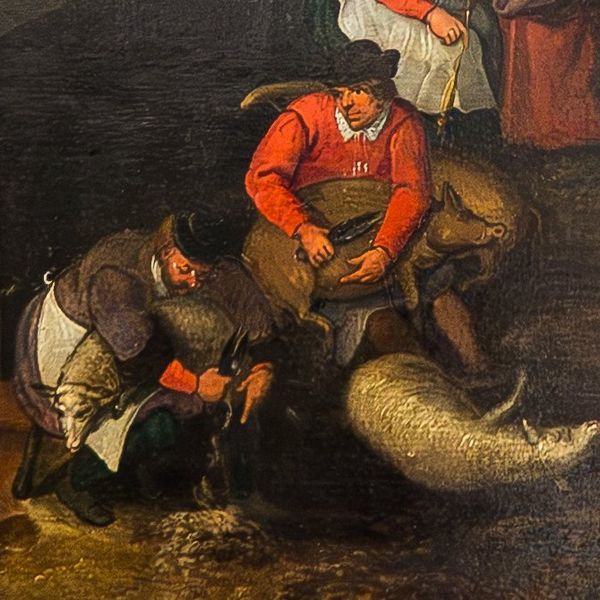
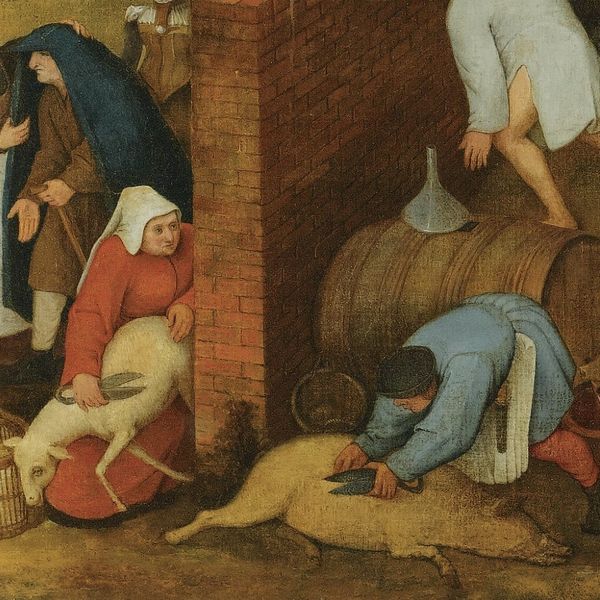
Two men sit side by side: one shears a sheep, its wool falling at his feet, the other shears a pig. A shorn sheep lies in front of them.[2]
Meaning
One lives in plenty, the other in want.[1] It was probably said of greedy, unscrupulous people.[1] To shear someone could also mean to rob him of his money.[3]
Disputed
A pig gives little wool. Another reading takes the pig-shearer from the old saying “much cry and little wool,” said of people who boast of doing much but achieve little.[4]
Did you know?
In a play of the Brussels chamber of rhetoric, printed in Antwerp in 1562, a character called Worldly Tricks asks what the others think of all those die tvercken laten en scheyren de schapen :audio{src="c6e945df-e3af-434d-9ee7-f81a02bd32bc/e2129f46-8ac3-48b0-aefb-975df9413a8a_nl_play_petra.mp3" lang="nl"}, who leave the pigs alone and shear the sheep. They answer together: they know the tricks of the world.[1]
In other pictures
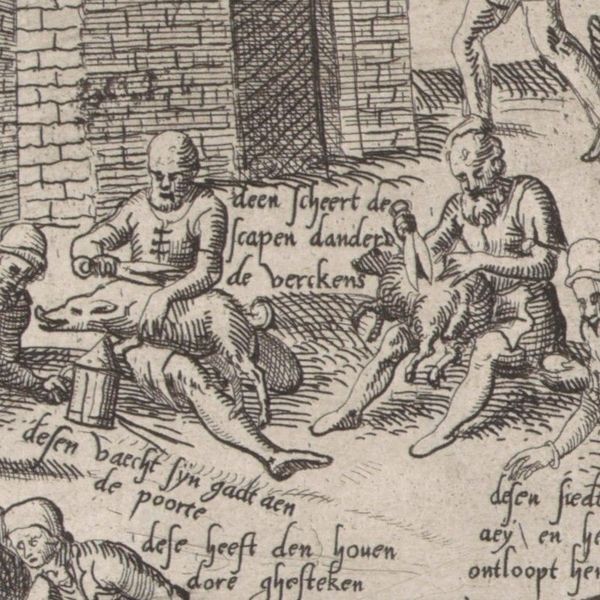
In Frans Hogenberg’s proverb print, which Bruegel most likely worked from, two men sit side by side, one shearing a pig, the other a sheep. The caption reads deen scheert de scapen dander de verckens :audio{src="c6e945df-e3af-434d-9ee7-f81a02bd32bc/e2129f46-8ac3-48b0-aefb-975df9413a8a_nl_hogenberg_petra.mp3" lang="nl"}, the one shears the sheep, the other the pigs.[5][6]
::other-pictures
 ::
The painting
::painting-intro ::
::sources
Roger H. Marijnissen, in Seidel and Marijnissen, Bruegel (New York, 1971), 40, no. 9.
Visible in the painting.
Cornelis Kiliaan, Etymologicum teutonicae linguae (Antwerp, 1599), 459.
Walter S. Gibson, Figures of Speech (Berkeley, 2010), 2, 157 n. 7.
Walter S. Gibson, Figures of Speech (Berkeley, 2010), 35.
Visible in the print: Frans Hogenberg, Die Blau Huicke, published by 1558; Rijksmuseum, Amsterdam. ::