kind: saying
Dutch: zij zou de duivel op een kussen binden :audio{src="c6e945df-e3af-434d-9ee7-f81a02bd32bc/f64239ad-8ca6-449c-90cf-522aeee3acd5_nl_petra.mp3" lang="nl"}[1]
What you see
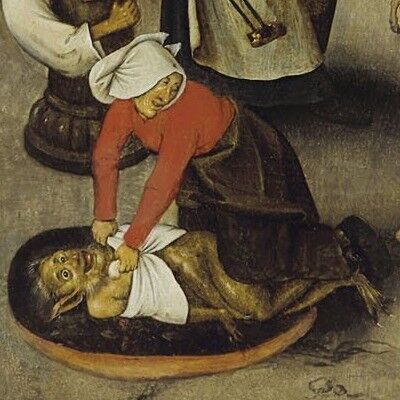
An old woman in a white headcloth, dressed in red, kneels over a small devil lying on his back on a large black cushion, and twists a white cloth tight around his chest. His wrists and shins are tied with cord. He screams; a red gash marks his forehead.[2] On the grass beside the cushion lies a wooden object. What it is remains open: it has been likened to an enema syringe,[1] and read as a spindle, lying ready as a weapon.[3]
Meaning
Said of a spiteful, quarrelsome woman.[1][4] In a sixteenth-century play, a drunken husband refuses to obey his wife, al waert een van die seven wijven die den duyvel opt kussen deden blijuen :audio{src="c6e945df-e3af-434d-9ee7-f81a02bd32bc/f64239ad-8ca6-449c-90cf-522aeee3acd5_nl_play_petra.mp3" lang="nl"}, even if she were one of the seven women who made the devil stay on the cushion.[1][5]
Disputed
One scholar finds a medical side to the scene. A Latin saying, taken from Saint Jerome into Erasmus’s collection of sayings, speaks of tying someone “with the chains of Hippocrates,” the ancient doctor. In the sixteenth century, madness was treated by cutting into the head and tying the patient to a mattress. The gash and the wooden object, which the copies lack, were probably added late, for a patron with an interest in medicine.[6]
Did you know?
An old rhyme says: ’t Was de beste Griet die men vond, die den Duivel op een kussen bond :audio{src="c6e945df-e3af-434d-9ee7-f81a02bd32bc/f64239ad-8ca6-449c-90cf-522aeee3acd5_nl_griet_petra.mp3" lang="nl"}, it was the best Griet one found who bound the devil on a cushion.[7] Griet, short for Margaret, was a name for an angry, wicked woman.[8] Why is not certain; perhaps because of Saint Margaret, said to have bound the devil on a cushion.[8] In one version of her legend, a dragon swallows her; she makes the sign of the cross, the dragon bursts, and she comes out unhurt.[9]
In other pictures
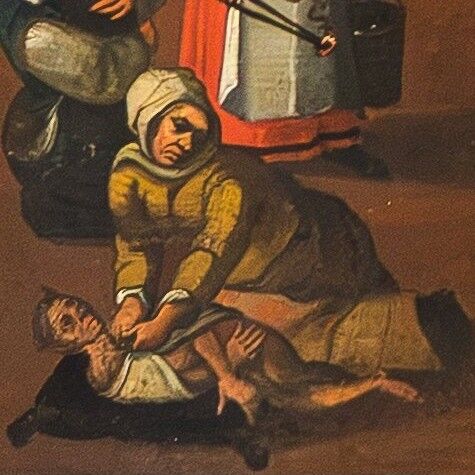
The copies have the scene, but without the red gash or the wooden object.[10][11]
::other-pictures
 ::
In the Aachen copy, the devil looks almost human.[11]
::other-pictures
 ::
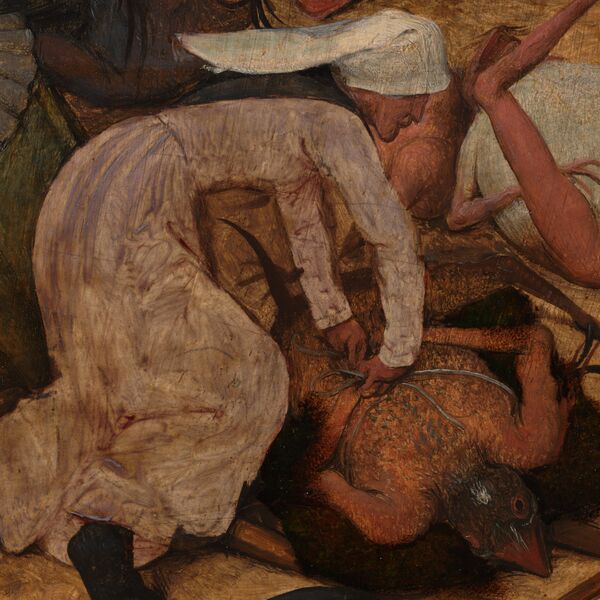
Frans Hogenberg’s proverb print does not have the scene.[10] Women binding devils come back in Bruegel’s Dulle Griet :audio{src="c6e945df-e3af-434d-9ee7-f81a02bd32bc/f64239ad-8ca6-449c-90cf-522aeee3acd5_nl_dulle_petra.mp3" lang="nl"} of 1561, on the ground.[3][12][13][14]
::other-pictures
 ::
The painting
::painting-intro ::
::sources
Roger H. Marijnissen, in Seidel and Marijnissen, Bruegel (New York, 1971), 38, no. 1.
Visible in the painting.
Yoko Mori, “Bruegel’s Netherlandish Proverbs and Corresponding Images in Old Japanese Art,” Acta historiae artium 44 (2003), 193.
Walter S. Gibson, Figures of Speech (Berkeley, 2010), 2.
Walter S. Gibson, Figures of Speech (Berkeley, 2010), 208 n. 77.
Margaret A. Sullivan, Bruegel and the Creative Process, 1559–1563 (Farnham, 2010), 38–39.
Carolus Tuinman, De oorsprong en uitlegging van dagelyks gebruikte Nederduitsche spreekwoorden, vol. 1 (1726), 23.
F. A. Stoett, Nederlandsche spreekwoorden, 4th ed. (Zutphen, 1923–25), no. 731.
Jacobus de Voragine, Legenda aurea, ch. 93, ed. Theodor Graesse (Leipzig, 1850), 401.
Margaret A. Sullivan, Bruegel and the Creative Process, 1559–1563 (Farnham, 2010), 38.
Visible in the copy.
Walter S. Gibson, Figures of Speech (Berkeley, 2010), 134.
Margaret A. Sullivan, Bruegel and the Creative Process, 1559–1563 (Farnham, 2010), 109.
Visible in the painting: Pieter Bruegel the Elder, Dulle Griet, 1561; Museum Mayer van den Bergh, Antwerp. ::